
Graduate Programs
Explore the programs offered by this organization.
The Center for Latin American Studies (CLAS) at Stanford is the university’s hub for interdisciplinary research on the region. CLAS is committed to rigorous, evidence-based investigation and teaching that highlights the complexity of Latin America and its many interacting components.
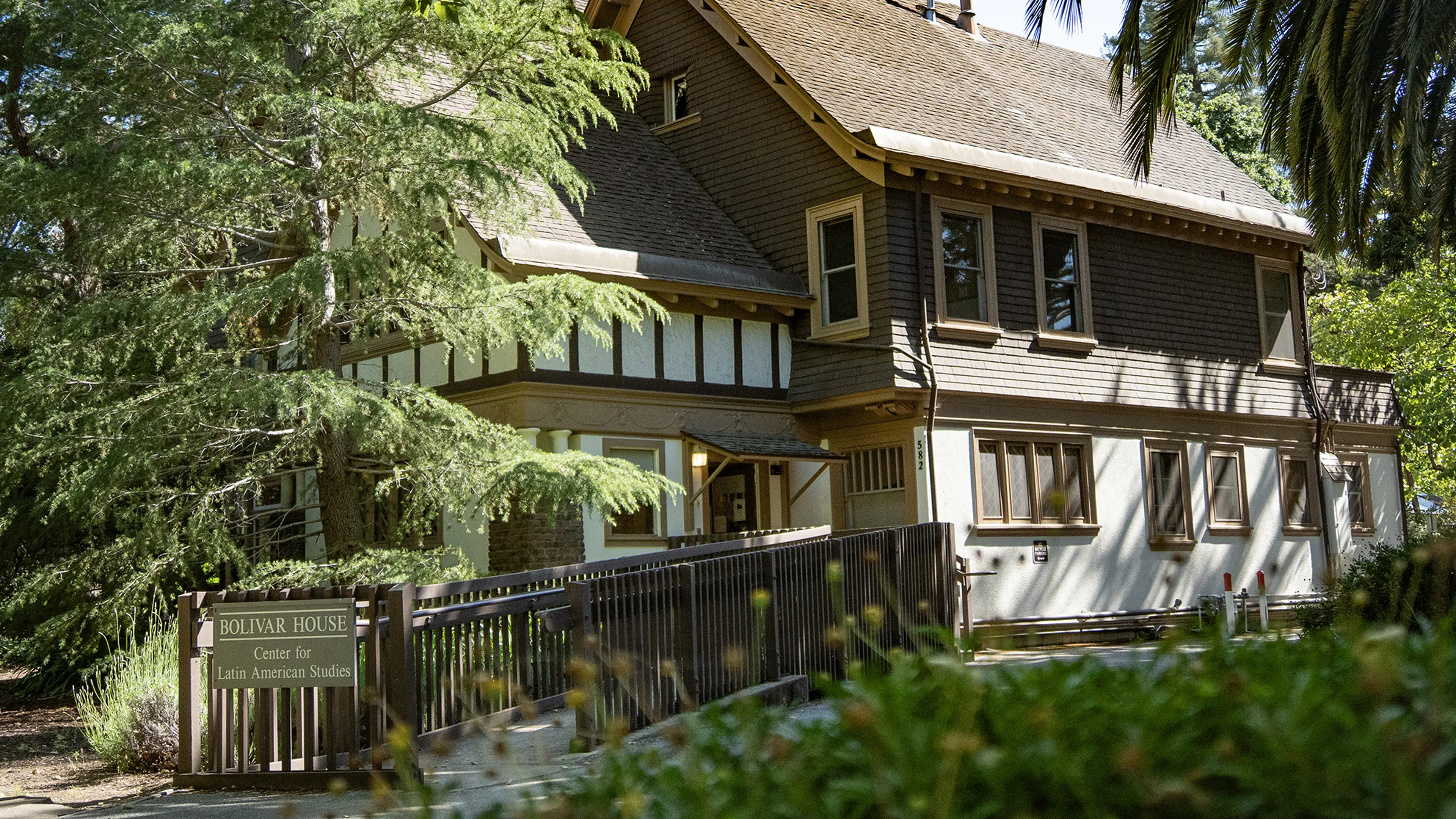
Located in the historic Bolívar House on Alvarado Row, we support faculty and student initiatives, including teaching, scholarly travel, and language study. Our partnerships include several private foundations and grant-making agencies. We also collaborate with distinct programs on campus focused on cultural studies, environmental studies, political science, public service, the Latin American diaspora, history, and others.
CLAS features state-of-the-art scholarship from different subregions and nations, with special attention to their complex interrelations. Our purview is vast, from Mexico to Patagonia and from Rapa Nui to Barbados. Our linguae francae are English, Spanish, and Portuguese. We are also grounded in Haitian Creole and in Indigenous languages, especially Quechua and Nahuatl.
CLAS’ origins go back to the 1940s when a group of Stanford faculty developed the Institute of Hispanic American and Luso-Brazilian Studies. By fall of 1965, the university established the Center for Latin American Studies, which has operated since then.
CLAS is committed to promoting “the public welfare by exercising an influence on behalf of humanity and civilization,” per Stanford University’s founding grant. In particular, CLAS seeks to advance scholarly knowledge towards social, economic, and environmental justice as well as democracy in Latin America.
CLAS falls under the division of Stanford Global Studies opens in a new tab in the School of Humanities and Sciences, offering multidisciplinary academic pathways to prepare students for professional careers or doctoral studies:
Master of Arts in Latin American Studies: The Master of Arts in Latin American Studies is an interdisciplinary program designed to develop students' knowledge and skills in the study of Latin America and to prepare them for professional careers or doctoral study. The curriculum comprises courses surveying the region, including its history, politics, society, ecology, and culture; advanced language training; research methodology; and focused coursework within the program's three fields of specialization (humanities, environment and health, and social sciences). Students with little prior coursework in Latin American Studies may benefit most from this interdisciplinary approach.
Coterminal Master’s Program: Undergraduates at Stanford may apply for admission to the coterminal master's program in Latin American Studies when they have earned a minimum of 120 units toward graduation — including advanced placement and transfer credit — and no later than the quarter prior to the expected completion of their undergraduate degree. Coterminal applicants must have a minimum GPA of 3.5 and meet the pre-entry language requirement.
Global Studies Minor with Specialization in Latin American Studies: Available to Stanford undergraduates from any major. This minor offers an interdisciplinary survey of Latin American history, politics, society, ecology, and culture, alongside in-depth language study. It is highly recommended for students planning service, research, or study abroad in the region.
Student Funding: Fueled by endowments including the Tinker Foundation, CLAS offers undergraduate and graduate grants. For undergraduates, the Center offers internship grants for self-arranged in-person summer internships. Awards range from $2,000 to $7,000 for full-time internships. For graduate students, the Center offers three distinct research travel grants: one for conference travel and two for field research. Awards range from $500 to $4,250. Together, these programs empower students to conduct transformative work through cultural immersion and hands-on discovery in the region.
The Center coordinates global collaborations, resource building, and academic exchange to enrich Latin-America area studies across all disciplines:
Tinker Visiting Professors: Hosting distinguished Latin American scholars annually who teach specialized courses, deliver public lectures, and collaborate with Stanford students and faculty.
Library Collections: Actively supporting Stanford University Libraries to strengthen its substantial Latin American and Iberian collections, which serve as invaluable resources for regional research.
Interdisciplinary Outreach: Collaborating with diverse on-campus programs focused on cultural studies, political science, environmental studies, history, public service, and the Latin American diaspora to analyze complex, transnational issues.
