Bulletin

Interested in attending Stanford?
Visit Undergraduate Admissions opens in a new tab or Graduate Admissions opens in a new tab.

Resources

  • About Stanford
  • About Bulletin
  • Academic Calendar opens in a new tab
  • Bulletin Archive
  • Enrollment Overview opens in a new tab
  • Enrollment Deadlines opens in a new tab
  • Degrees at a Glance

Schools

  • Doerr School of Sustainability opens in a new tab
  • Graduate School of Business opens in a new tab
  • Graduate School of Education opens in a new tab
  • School of Engineering opens in a new tab
  • School of Humanities and Science opens in a new tab
  • School of Law opens in a new tab
  • School of Medicine opens in a new tab
Give Feedback

Stanford University is accredited by the Accrediting Commission of Senior Colleges and Universities of the Western Association of Schools and Colleges opens in a new tab.

Give Feedback
Stanford
University
  • Stanford Home
  • Maps & Directions
  • Search Stanford
  • Emergency Info
  • Terms of Use
  • Privacy
  • Copyright
  • Trademarks
  • Non-Discrimination
  • Accessibility
© Stanford University.  Stanford, California 94305.
Skip to main content
Stanford University
Bulletin
Chemistry
Natural Sciences
Skip past section menu
Schools, Departments, and Organizations
  • Doerr School of Sustainability
  • Graduate School of Business
  • Graduate School of Education
  • Law School
  • School of Engineering
  • School of Humanities and Sciences
    • African and African-American Studies
    • American Studies
    • Anthropology
    • Applied Physics
    • Archaeology
    • Art and Art History
    • Biology
    • Biophysics
    • Center for Human Rights and International Justice
    • Chemistry
    • Civic Thought and Practice
    • Classics
    • Communication
    • Comparative Literature
    • Comparative Studies in Race and Ethnicity
    • Data Science
    • Division of Literatures, Cultures, and Languages
    • East Asian Languages and Cultures
    • East Asian Studies
    • Economics
    • English
    • Ethics in Society
    • Feminist, Gender, and Sexuality Studies
    • Freeman Spogli Institute for International Studies
    • French and Italian
    • German Studies
    • History
    • Human Biology
    • Iberian and Latin American Cultures
    • International Policy
    • International Relations
    • Language Center
    • Latin-American Studies
    • Linguistics
    • Mathematics
    • MLA Program
    • Modern Thought and Literature
    • Music
    • Philosophy
    • Physics
    • Political Science
    • Psychology
    • Public Policy
    • Religious Studies
    • Russian, East European, and Eurasian Studies
    • Science, Technology, and Society
    • Scientific Computing and Computational Math
    • Slavic Languages and Literatures
    • Sociology
    • Stanford Arts Institute
    • Stanford Global Studies
    • Stanford in Washington
    • Statistics
    • Symbolic Systems
    • Theater and Performance Studies
    • Urban Studies
  • School of Medicine
Units and other organizations
  • Athletics, Physical Education, and Recreation
  • Center for Teaching and Learning
  • SLAC National Accelerator Laboratory
  • Vice Provost for Graduate Education
  • Vice Provost for Undergraduate Education
Loading department
Loading programs and courses
Loading department contacts
  1. Home
  2. Schools, Departments, & Units
  3. School Of Humanities And Sciences
  4. Chemistry

Chemistry

About Us

The Department of Chemistry at Stanford University is a world-class center for molecular discovery, scientific innovation, and education. Often called the "Central Science," chemistry at Stanford serves as the essential key to explaining the physical world. The discipline explores the very nature of matter: how to create it, measure it, model it, and manipulate it at the atomic and molecular levels.

Traditionally divided into subdisciplines such as organic, inorganic, physical, biological, theoretical, and analytical chemistry, the boundaries between these fields are increasingly fluid at Stanford. Our department operates as a highly collaborative, interconnected ecosystem. Together, our faculty, postdoctoral scholars, graduate students, and undergraduates work side-by-side to develop solutions to some of humanity's most pressing challenges—from engineering novel therapeutics and nanomaterials to driving environmental sustainability and clean energy solutions.

Academic Programs and Molecular Training

The Department of Chemistry provides rigorous, hands-on educational pathways designed to cultivate analytical rigor, laboratory expertise, and scientific leadership:

  • Undergraduate Program (B.S. and Minor): Offering a comprehensive foundation in chemical principles alongside advanced laboratory training. Undergraduates are highly encouraged to integrate into faculty research groups, applying their classroom knowledge to real-world challenges in biotechnology, medicine, materials science, and environmental engineering.

  • Graduate Program (Ph.D.): A premier, research-intensive doctoral program that prepares scholars for leading roles in academia, the biotechnology and pharmaceutical industries, and national laboratories. Graduate students design and execute original research, mastering advanced instrumentation and computational tools under the mentorship of world-renowned faculty.

Research Frontiers and Molecular Innovation

Research in the department focuses on analyzing and harnessing the properties of complex systems, from observing the electronic structures of molecules as small as dihydrogen (H2H_2H2​) to synthesizing massive, multi-component polymer assemblies. Key areas of scientific inquiry include:

  • Chemical Biology and Drug Discovery: Synthesizing complex organic molecules to probe cellular ion channels, developing novel molecular probes to visualize biological processes, and identifying targets for next-generation therapeutics.

  • Nanotechnology and Materials Chemistry: Manipulating carbon nanotubes, engineering functional nanomaterials, and fabricating advanced polymers with tailored electrical, mechanical, and optical properties.

  • Catalysis and Green Synthesis: Designing novel oxidation and polymerization catalysts to enable highly efficient, sustainable, and environmentally friendly chemical manufacturing processes.

  • Theoretical and Computational Chemistry: Utilizing quantum mechanics, statistical mechanics, and advanced computer modeling to simulate protein folding, predict molecular reactivity, and map complex chemical dynamics.

  • Physical and Biophysical Chemistry: Applying ultra-sensitive spectroscopic, imaging, and analytical techniques to measure and characterize the structural dynamics of complex molecular systems in real time.

Our Offerings

  • Undergraduate Programs

    Explore the programs offered by this organization.
  • Graduate Programs

    Explore the programs offered by this organization.
  • Courses

    Explore the courses offered by this organization.

Find Us on Campus

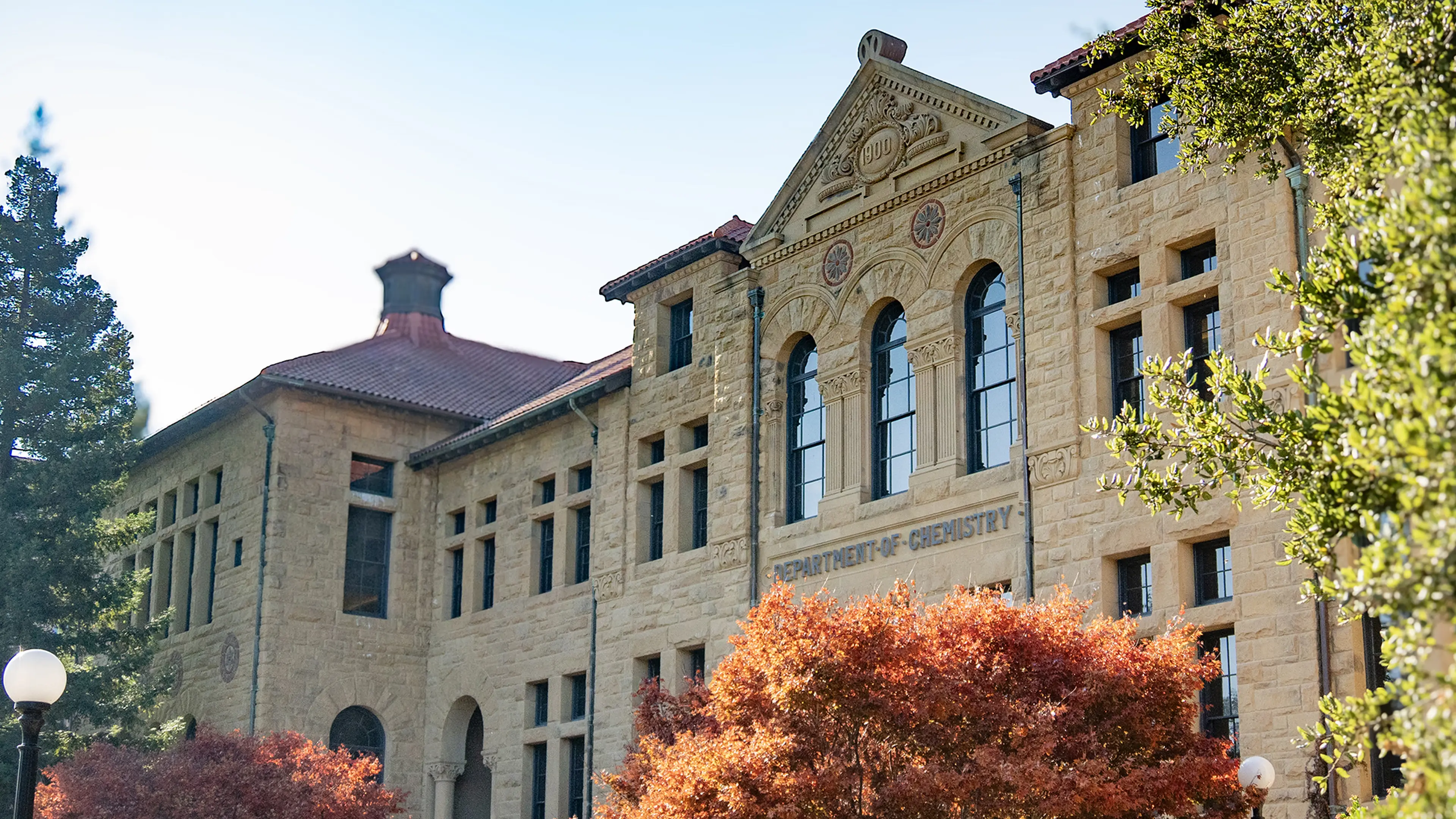
Chemistry opens in a new tab
We welcome your inquiries and look forward to connecting with you. Reach out to us through any of the channels below.
Address
Department of Chemistry 
Stanford University 
Central Chemistry Office 
337 Campus Drive West 
Stanford, CA 94305
opens in a new tab
Phone
(650) 723-2501 opens in a new tab

Directories

  • Our Faculty
  • Emeriti Faculty
  • Courtesy Faculty
  • Lectureres
  • Staff

Key Contacts

  • Justin Du Bois
    Department Chair
  • Jennifer Schwartz Poehlmann
    Director of Undergraduate Studies
  • Bianxiao Cui
    Director of Graduate Studies
  • Yan Xia
    Director of Graduate Studies