Bulletin

Interested in attending Stanford?
Visit Undergraduate Admissions opens in a new tab or Graduate Admissions opens in a new tab.

Resources

  • About Stanford
  • About Bulletin
  • Academic Calendar opens in a new tab
  • Bulletin Archive
  • Enrollment Overview opens in a new tab
  • Enrollment Deadlines opens in a new tab
  • Degrees at a Glance

Schools

  • Doerr School of Sustainability opens in a new tab
  • Graduate School of Business opens in a new tab
  • Graduate School of Education opens in a new tab
  • School of Engineering opens in a new tab
  • School of Humanities and Science opens in a new tab
  • School of Law opens in a new tab
  • School of Medicine opens in a new tab
Give Feedback

Stanford University is accredited by the Accrediting Commission of Senior Colleges and Universities of the Western Association of Schools and Colleges opens in a new tab.

Give Feedback
Stanford
University
  • Stanford Home
  • Maps & Directions
  • Search Stanford
  • Emergency Info
  • Terms of Use
  • Privacy
  • Copyright
  • Trademarks
  • Non-Discrimination
  • Accessibility
© Stanford University.  Stanford, California 94305.
Skip to main content
Stanford University
Bulletin
Biophysics
Interdisciplinary Programs
Skip past section menu
Schools, Departments, and Organizations
  • Doerr School of Sustainability
  • Graduate School of Business
  • Graduate School of Education
  • Law School
  • School of Engineering
  • School of Humanities and Sciences
    • African and African-American Studies
    • American Studies
    • Anthropology
    • Applied Physics
    • Archaeology
    • Art and Art History
    • Biology
    • Biophysics
    • Center for Human Rights and International Justice
    • Chemistry
    • Civic Thought and Practice
    • Classics
    • Communication
    • Comparative Literature
    • Comparative Studies in Race and Ethnicity
    • Data Science
    • Division of Literatures, Cultures, and Languages
    • East Asian Languages and Cultures
    • East Asian Studies
    • Economics
    • English
    • Ethics in Society
    • Feminist, Gender, and Sexuality Studies
    • Freeman Spogli Institute for International Studies
    • French and Italian
    • German Studies
    • History
    • Human Biology
    • Iberian and Latin American Cultures
    • International Policy
    • International Relations
    • Language Center
    • Latin-American Studies
    • Linguistics
    • Mathematics
    • MLA Program
    • Modern Thought and Literature
    • Music
    • Philosophy
    • Physics
    • Political Science
    • Psychology
    • Public Policy
    • Religious Studies
    • Russian, East European, and Eurasian Studies
    • Science, Technology, and Society
    • Scientific Computing and Computational Math
    • Slavic Languages and Literatures
    • Sociology
    • Stanford Arts Institute
    • Stanford Global Studies
    • Stanford in Washington
    • Statistics
    • Symbolic Systems
    • Theater and Performance Studies
    • Urban Studies
  • School of Medicine
Units and other organizations
  • Athletics, Physical Education, and Recreation
  • Center for Teaching and Learning
  • SLAC National Accelerator Laboratory
  • Vice Provost for Graduate Education
  • Vice Provost for Undergraduate Education
Loading department
Loading programs and courses
Loading department contacts
  1. Home
  2. Schools, Departments, & Units
  3. School Of Humanities And Sciences
  4. Biophysics

Biophysics

About Us

The Stanford Biophysics Program is a premier, interdisciplinary, and interdepartmental doctoral training program dedicated to understanding biological function in terms of physical and chemical principles. Established to bridge the gap between the physical and biological sciences, the program brings together outstanding faculty from 16 departments across the School of Humanities and Sciences, the School of Medicine, the School of Engineering, and the SLAC National Accelerator Laboratory (including the Stanford Synchrotron Radiation Lightsource).

Research within the Biophysics Program is organized around two deeply integrated, overlapping frontiers: the application of physical and chemical principles to solve fundamental biological problems, and the development of next-generation physical technologies and computational methods. By training students at this intersection, the program equips them to map the molecular mechanics of life and drive innovations that impact biotechnology, medicine, and planetary health.

Academic Programs and Training

The Biophysics program offers highly customized doctoral training designed to accommodate and leverage the diverse academic backgrounds of its students—whether they enter with foundations in physics, chemistry, mathematics, engineering, or biology:

  • Doctor of Philosophy (Ph.D.) in Biophysics: A rigorous, research-focused doctoral pathway. Because of the interdepartmental nature of the program, admitted students have the unique freedom to conduct their dissertation research in any participating laboratory across Stanford’s schools.

  • Customized Curricula: The program tailors academic coursework to individual student backgrounds, ensuring a solid foundation in both quantitative physical sciences and advanced molecular biology.

  • First-Year Lab Rotations: Students complete a series of research rotations in different laboratories during their first year, allowing them to explore diverse scientific questions, experimental setups, and computational models before selecting a primary thesis advisor.

  • Professional Development: Training includes active participation in scientific seminars, rigorous qualification exams, and extensive mentorship in writing grant proposals, presenting to diverse scientific audiences, and teaching.

Research Frontiers and Methodologies

Biophysics researchers at Stanford work at the absolute limits of spatial and temporal resolution, deploying and developing cutting-edge methodologies:

  • Structural Biology & Macromolecular Mechanics: Utilizing state-of-the-art cryogenic electron microscopy (cryo-EM), X-ray crystallography, nuclear magnetic resonance (NMR), and mass spectrometry to map the atomic structures of proteins, nucleic acids, and molecular complexes.

  • Single-Molecule Biophysics & Spectroscopy: Developing and applying optical tweezers, magnetic traps, and single-molecule fluorescence microscopy to observe biological machines, molecular motors, and DNA replication systems in real time at the nanometer scale.

  • Computational & Theoretical Biophysics: Leveraging high-performance computing, molecular dynamics (MD) simulations, and machine learning/AI algorithms to model protein folding, predict macromolecular interactions, and reconstruct complex cellular networks.

  • Advanced Imaging and Optics: Creating super-resolution microscopy platforms, optogenetic tools, and novel biosensors to image and manipulate physical processes inside living cells and tissues.

  • Synthetic Biology & Biomaterials: Engineering novel synthetic molecular circuits, cellular sensors, and bio-inspired materials from the bottom up.

Our Offerings

  • Graduate Programs

    Explore the programs offered by this organization.
  • Courses

    Explore the courses offered by this organization.

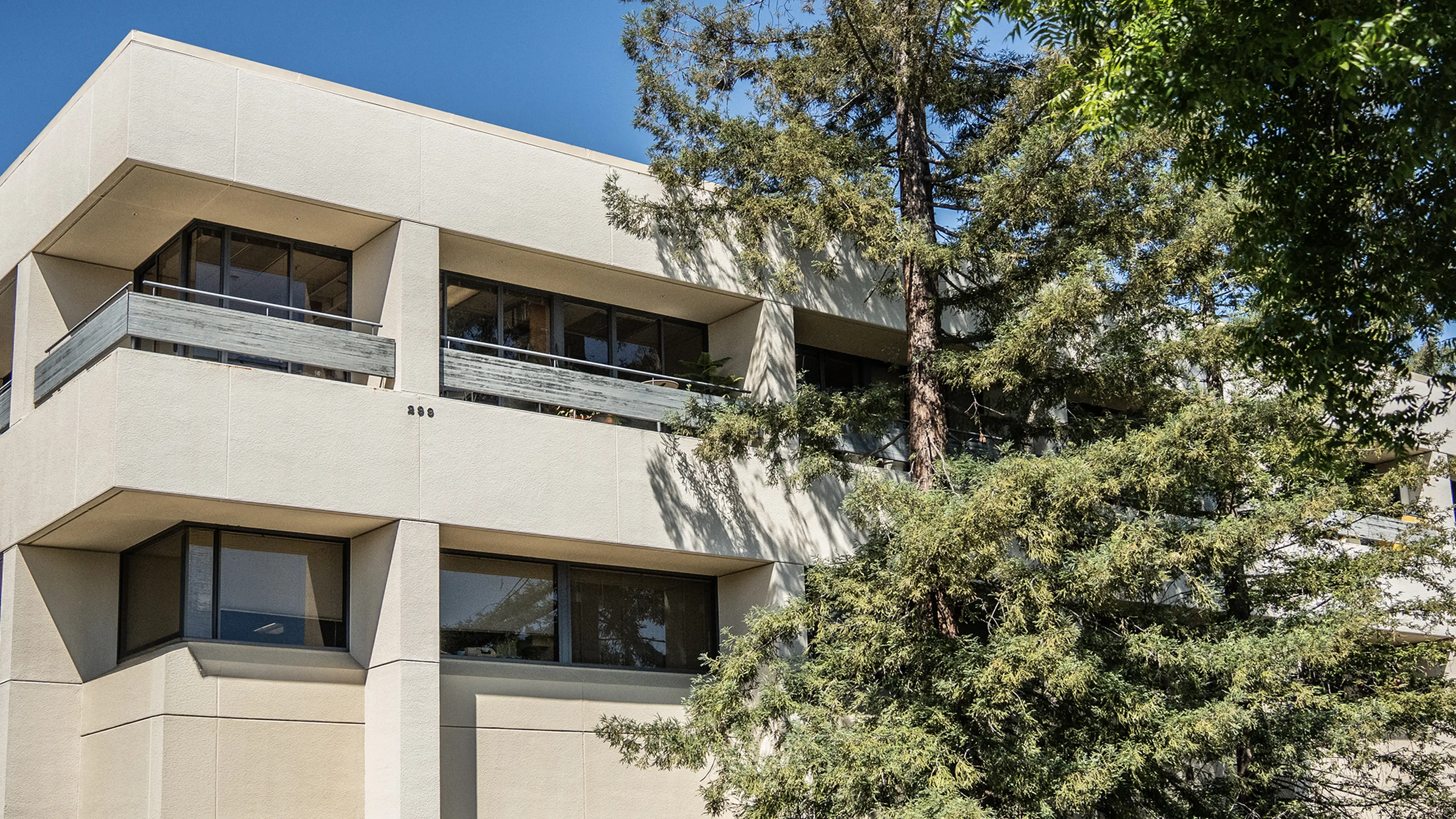
Find Us on Campus

Biophysics opens in a new tab
We welcome your inquiries and look forward to connecting with you. Reach out to us through any of the channels below.
Address
Biophysics Program
Stanford University School of Medicine
300 Pasteur Drive, Alway Building, M116I
Stanford, CA 94305
opens in a new tab
Phone
(650) 723-7576 opens in a new tab
Inquiries
biophys-ssa@lists.stanford.edu opens in a new tab

Directories

  • Our Faculty

Key Contacts

  • Zev Bryant
    Director of Graduate Studies