Bulletin

Interested in attending Stanford?
Visit Undergraduate Admissions opens in a new tab or Graduate Admissions opens in a new tab.

Resources

  • About Stanford
  • About Bulletin
  • Academic Calendar opens in a new tab
  • Bulletin Archive
  • Enrollment Overview opens in a new tab
  • Enrollment Deadlines opens in a new tab
  • Degrees at a Glance

Schools

  • Doerr School of Sustainability opens in a new tab
  • Graduate School of Business opens in a new tab
  • Graduate School of Education opens in a new tab
  • School of Engineering opens in a new tab
  • School of Humanities and Science opens in a new tab
  • School of Law opens in a new tab
  • School of Medicine opens in a new tab
Give Feedback

Stanford University is accredited by the Accrediting Commission of Senior Colleges and Universities of the Western Association of Schools and Colleges opens in a new tab.

Give Feedback
Stanford
University
  • Stanford Home
  • Maps & Directions
  • Search Stanford
  • Emergency Info
  • Terms of Use
  • Privacy
  • Copyright
  • Trademarks
  • Non-Discrimination
  • Accessibility
© Stanford University.  Stanford, California 94305.
Skip to main content
Stanford University
Bulletin
Environmental Social Sciences
Doerr School of Sustainability
Skip past section menu
Schools, Departments, and Organizations
  • Doerr School of Sustainability
    • Civil and Environmental Engineering
    • Earth and Planetary Sciences
    • Earth System Science
    • Earth Systems
    • Emmett Interdisciplinary Program in Environment and Resources
    • Energy Science and Engineering
    • Environmental Social Sciences
    • Geophysics
    • Oceans
    • Sustainability Science and Practice
  • Graduate School of Business
  • Graduate School of Education
  • Law School
  • School of Engineering
  • School of Humanities and Sciences
  • School of Medicine
Units and other organizations
  • Athletics, Physical Education, and Recreation
  • Center for Teaching and Learning
  • SLAC National Accelerator Laboratory
  • Vice Provost for Graduate Education
  • Vice Provost for Undergraduate Education
Loading department
Loading programs and courses
Loading department contacts
  1. Home
  2. Schools, Departments, & Units
  3. Doerr School Of Sustainability
  4. Environmental Social Sciences

Environmental Social Sciences

About Us

The Department of Environmental Social Sciences (ESoS) is the newest department within the Stanford Doerr School of Sustainability. Recognizing that the world's most pressing sustainability challenges stem from human choices, ESoS operates on the premise that the solutions to these crises must also come from understanding, predicting, and changing human behavior and institutions.

The department comprises a rapidly growing community of scholars with diverse disciplinary backgrounds, spanning economics, political science, sociology, psychology, history, anthropology, geography, law, decision science, and the learning sciences. United by a shared mission to align human systems with planetary boundaries, ESoS faculty conduct research to investigate the root causes of humanity's environmental challenges; design and evaluate effective public policies, business strategies, and behavioral interventions; and train future scholars and leaders to drive systemic change.

Academic Programs and Pathways

ESoS is building cutting-edge academic pathways designed to equip students with rigorous qualitative and quantitative social science methodologies:

  • Doctor of Philosophy (Ph.D.) in Environmental Social Sciences: A premier, research-intensive doctoral program. Ph.D. candidates engage in deep disciplinary and interdisciplinary training, preparing for careers in academia, policy design, non-governmental organizations, and the private sector.

  • Undergraduate and Master's Contributions: While the department focuses primarily on graduate-level training, its faculty teach and advise students within the school's broader interdisciplinary programs, including the Earth Systems Program opens in a new tab and E-IPER opens in a new tab.

Core Research Areas and Collaborations

Research within the department is organized around two broad, collaborative areas of inquiry that integrate diverse social science disciplines:

  • Global Environmental Policy (GEP): Drawing heavily from economics, political science, data science, and international relations, GEP faculty focus on the design, evaluation, and implementation of institutions and policies. Research in this area seeks to identify which policy, technological, or institutional approaches are economically optimal, politically feasible, and socially equitable to jointly improve environmental and human outcomes.

  • Environmental Behavioral Science (EBS): Bridging sociology, psychology, history, anthropology, geography, law, decision science, and the learning sciences, EBS faculty study human behavior, human ecology, and social institutions. This area of inquiry explores how individuals, communities, and organizations perceive environmental risks and how behavioral interventions can scale up sustainability efforts.

Our Offerings

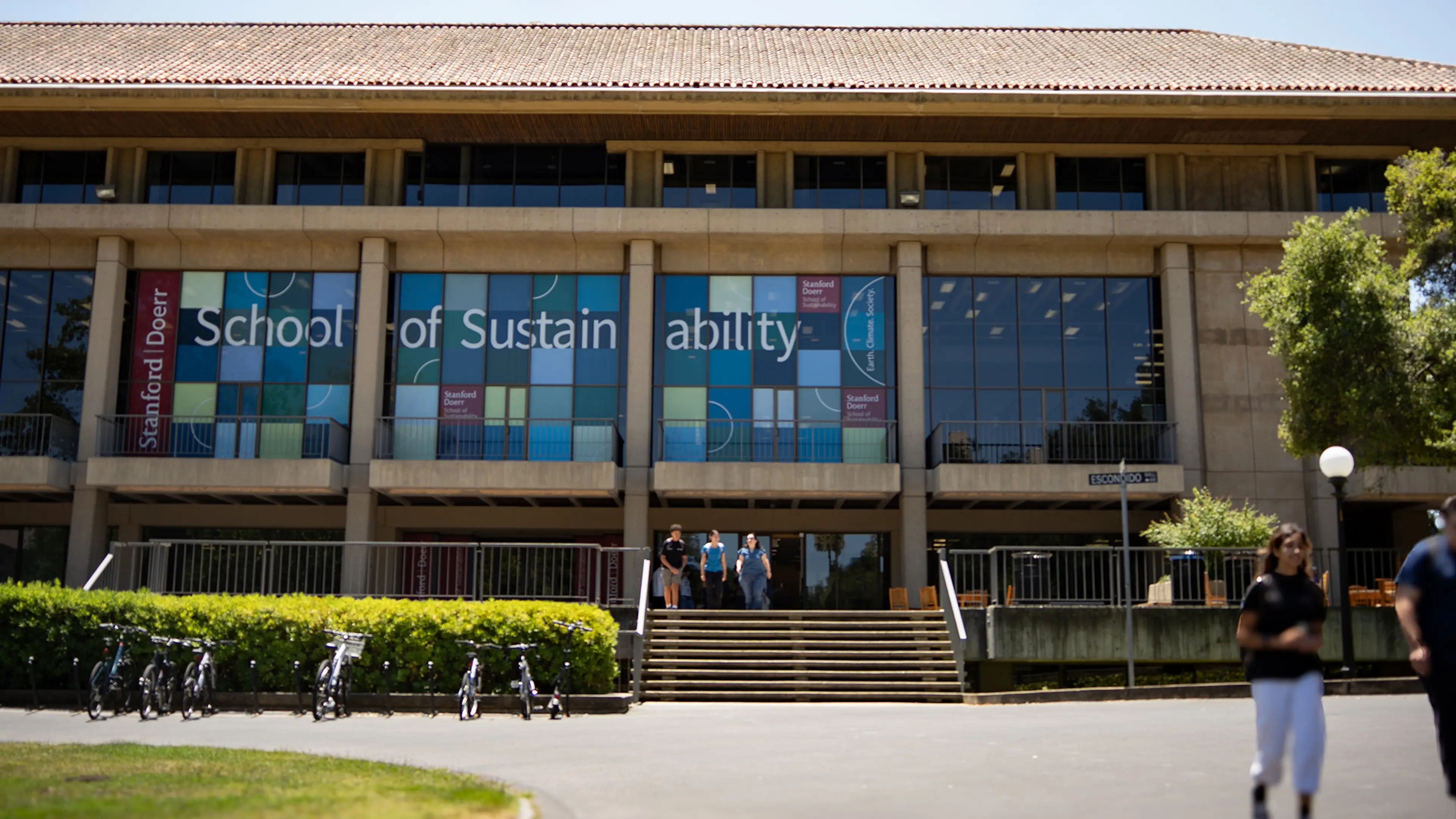
  • Graduate Programs

    Explore the programs offered by this organization.
  • Courses

    Explore the courses offered by this organization.

Find Us on Campus

Environmental Social Sciences opens in a new tab
We welcome your inquiries and look forward to connecting with you. Reach out to us through any of the channels below.
Address
Jerry Yang and Akiko Yamazaki Environment and Energy Building
473 Via Ortega, Room 350
Stanford, CA  94305
opens in a new tab
Phone
(650) 721-3724 opens in a new tab
Inquiries
esosadmissions@stanford.edu opens in a new tab

Directories

  • Our Faculty
  • Postdoctoral Scholars
  • Our Staff

Key Contacts

  • William Barnett
    Department Chair (EBS)
  • Marshall Burke
    Deputy Chair (GEP)
  • Nicole Ardoin
    Director of Graduate Studies (EBS)
  • Solomon Hsiang
    Director of Graduate Studies (GEP)