
Graduate Programs
Explore the programs offered by this organization.
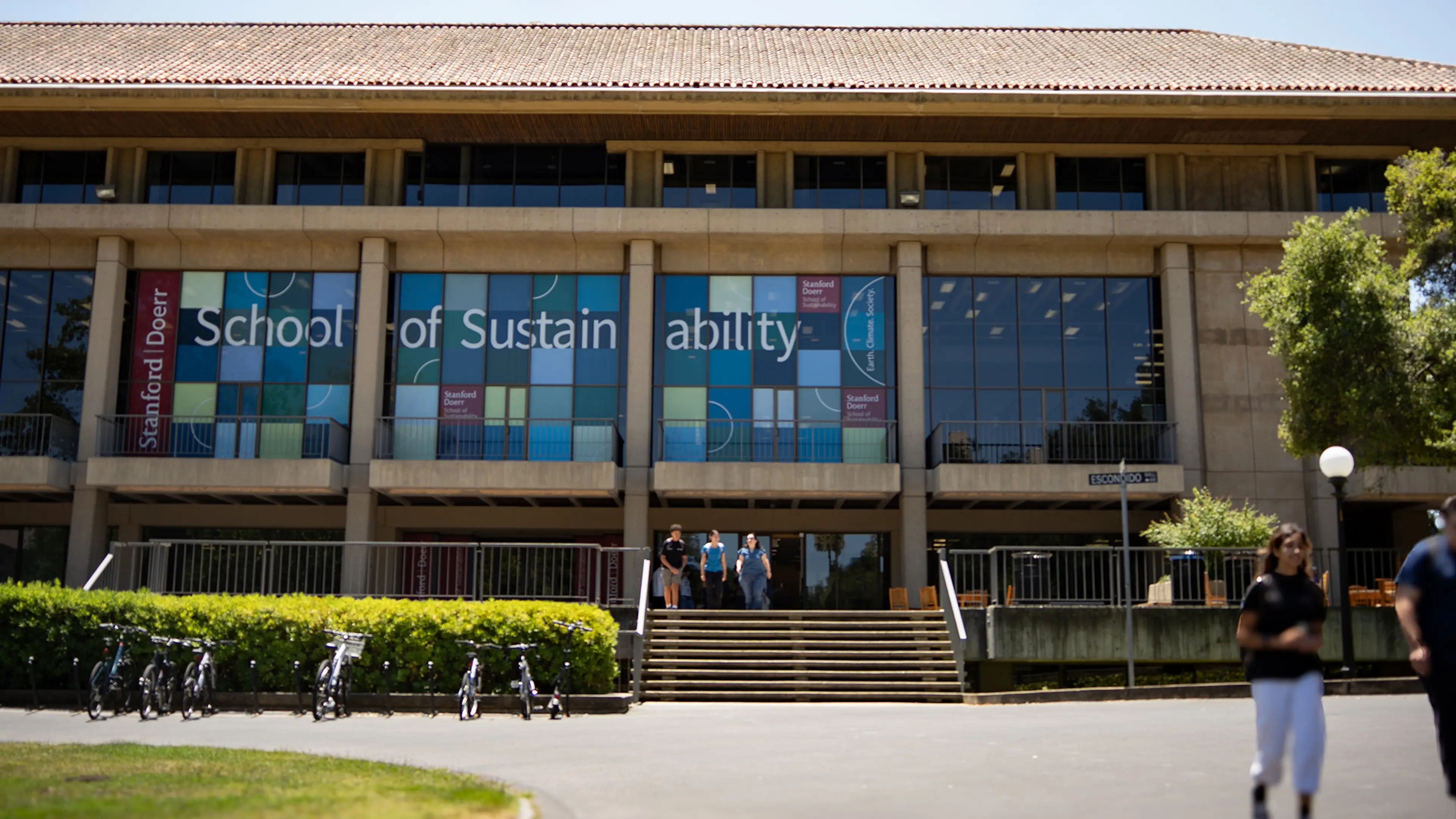
The Emmett Interdisciplinary Program in Environment and Resources (E-IPER) is an interdisciplinary graduate program for environmental scholarship and leadership. Founded in 2001 and housed within the Doerr School of Sustainability, E-IPER prepares researchers and leaders to address complex environmental and resource challenges through interdisciplinary research and practice.
E-IPER offers customizable, interdisciplinary graduate pathways through which students investigate environmental and resource challenges and connect this learning to their research, professional education, and practice.
Doctor of Philosophy (Ph.D.) in Environment and Resources: A research-focused doctoral program in which students develop individualized curricula and original research agendas addressing significant environmental and resource challenges. Students integrate knowledge, theories, and methods across distinct areas of study in their dissertation research, guided by faculty advisors and committees whose expertise reflects the interdisciplinary scope of their work.
Joint Master of Science (M.S.) in Environment and Resources: Offered exclusively to students concurrently pursuing a J.D. at Stanford Law School or an M.B.A. at the Stanford Graduate School of Business. The program complements students’ legal or business education with an individualized course of study focused on the scientific or engineering dimensions of environmental challenges.
Dual Master of Science (M.S.) in Environment and Resources: Offered to students concurrently pursuing a masters program (excluding the MBA and MSX), or a Ph.D. in another academic department at Stanford. The program complements students’ primary graduate studies with an individualized course of study focused on the scientific or engineering dimensions of environmental challenges.
E-IPER is not organized around a prescribed set of disciplinary combinations. Instead, students develop depth in fields relevant to their questions while learning to draw upon and integrate frameworks, methods, and evidence across disciplinary boundaries. Drawing on faculty and courses from all seven Stanford schools, students engage with fields spanning the natural and Earth sciences, engineering, social sciences, humanities, health, law, policy, and business.
Ph.D. students define two distinct Areas of Concentration: established domains of academic inquiry, each with its own scholarly literature, theories, and methods. Students develop expertise in both areas, grounding them in recognized scholarly communities while preparing them to produce original research at the intersection of their chosen fields.
Joint and Dual M.S. students deepen their understanding of the scientific or engineering dimensions of environmental challenges and integrate that knowledge into their respective graduate fields.
Across both programs, students learn to use complementary disciplinary perspectives to frame complex problems, evaluate evidence, and develop rigorous and applicable insights.