
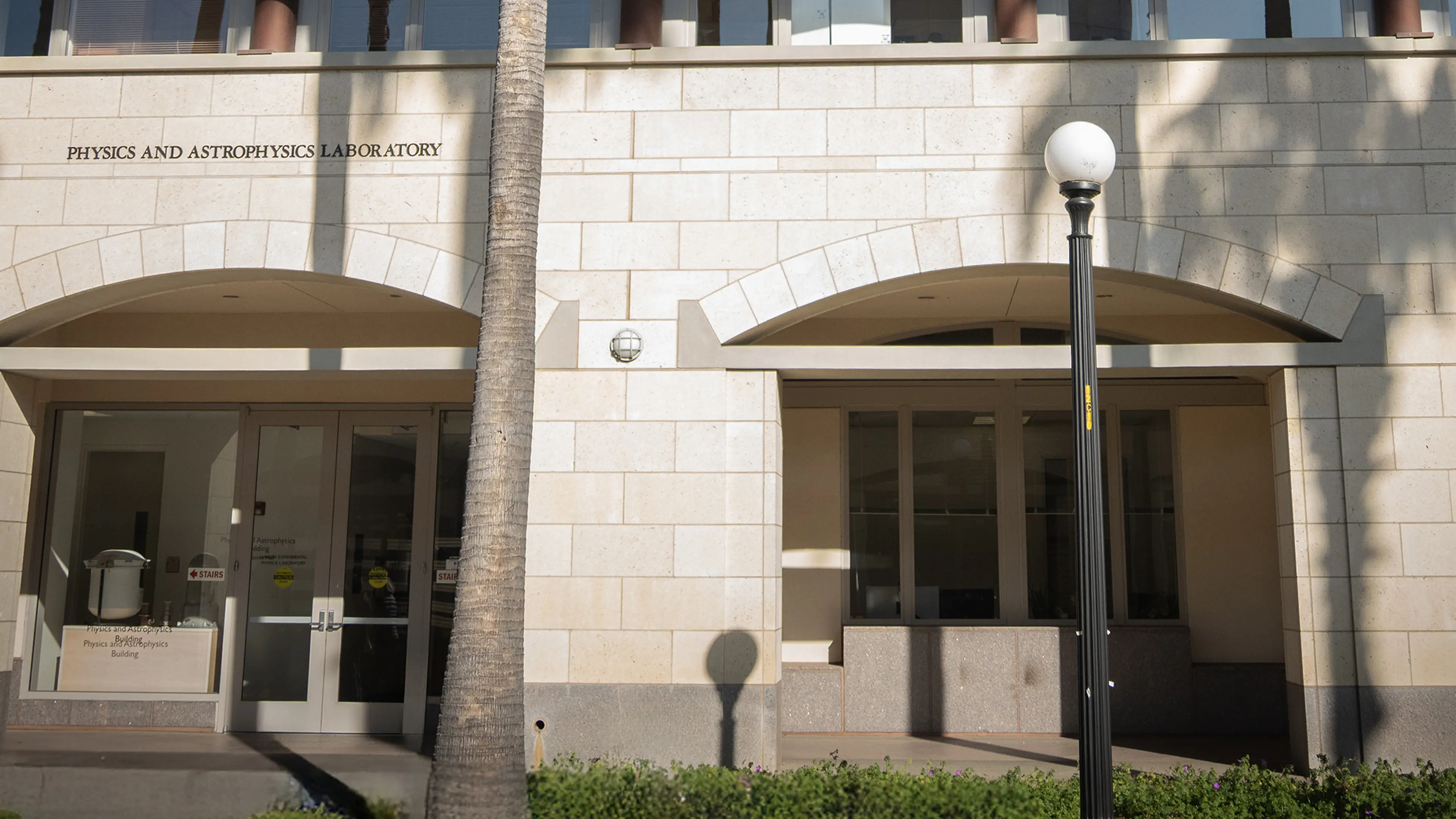
Major: Bachelor of Science
MajorOverview
The undergraduate program in Physics aims to provide students with a strong foundation in classical and modern physics. The program develops quantitative problem-solving skills and the ability to conceive experiments and analyze and interpret data. These abilities are acquired through both coursework and opportunities to conduct independent research. The program prepares students for careers in fields that benefit from quantitative and analytical thinking, including physics, engineering, teaching, medicine, law, science writing, and science policy in government or the private sector. Sometimes, the path to this career will be through an advanced degree in physics or a professional program.
Physics is concerned with a rigorous, mathematical understanding of the fundamental laws that govern our universe and everything in it. The Physics major provides students with a foundational knowledge of the pillars of modern physics: mechanics, electromagnetic theory, quantum mechanics, and statistical mechanics. The major is designed around a range of pathways that allow students the flexibility to explore a particular interest in more depth, including but not limited to astrophysics, biophysics, computational and mathematical physics, education, geophysics, and quantum information science.
Physics majors have pursued careers in basic or applied research, teaching, and policy, as well as in many parts of the private sector as engineers, consultants, and founders of startups. Others have combined the Physics major with a minor or major in the humanities and pursued careers in the arts.
Physics majors often pursue advanced degrees, including coterminal master’s degrees in Electrical Engineering, Computer Science, Applied & Engineering Physics, Statistics and other fields, and PhD programs in physics or other fields.
Requirements
Each Physics major takes:
A set of required courses common to all pathways (Core Program Requirements, WIM, and Capstone).
An additional six courses in one of eight defined pathways or, in rare cases, an individually designed pathway.
The eight defined pathways (found in the "Depth in Discipline" section) are: Astrophysics, Biophysics, Computational Physics & Data Science, Geophysics, Mathematical Physics, Physics Education, Quantum Science & Information, or the Core pathway.
See these sample plans for starting the Physics and Engineering Physics majors opens in a new tab for students enrolling in autumn 2022 or later; each plan assumes a different starting point in math and/or physics. Course plans for pursuing different Physics pathways opens in a new tab are provided below the sample plans for the start of the major spreadsheet.
Core Program Requirements
Introductory Physics Courses (23 units)
PHYSICS 41
Mechanics

PHYSICS 41E
Mechanics, Concepts, Calculations, and Context
PHYSICS 43
Electricity and Magnetism
PHYSICS 61
Mechanics and Special Relativity
PHYSICS 61L
Mechanics Laboratory
PHYSICS 71
Quantum and Thermal Physics
PHYSICS 79L
Introduction to Data Analysis, with Python and Jupyter
PHYSICS 89L
Introduction to Data Analysis, with Python and Jupyter
PHYSICS 81
Electricity and Magnetism Using Special Relativity and Vector Calculus
PHYSICS 81L
Introduction to Experimental Practice
PHYSICS 71L
Modern Physics Laboratory
Note that some students may be able to place out of Physics 41 and/or 43 based on advice from the Physics Placement Diagnostic opens in a new tab, as described under the “Additional Program Policies”.
Although not generally recommended, students with sufficient lab preparation who do not take all three required introductory lab courses may substitute an extra advanced lab course (PHYSICS 100, 104, 106, or 108) for all three required introductory labs. In this case, taking any of the introductory labs does not reduce the extra advanced lab requirement. Generally, only an extra advanced lab, not any other courses, may substitute for the intro labs. A student must apply using the usual course substitution form to make this substitution.
Introductory Math Courses (18-19 units)
Math Series
Complete Either the MATH 50 or 60CM Series
Before taking Math 51 or Math 61CM, students will need to complete Math 19, 20, and 21 or AP Calculus BC (score of 5). This may require up to 10 units of coursework in addition to the Physics BS requirement.
Additional Math Course
MATH 131P
Partial Differential Equations
MATH 173
Theory of Partial Differential Equations
MATH 220A
Partial Differential Equations of Applied Mathematics
PHYSICS 111
Partial Differential Equations of Mathematical Physics
Intermediate Physics Courses (12 units)
PHYSICS 120
Electromagnetism
PHYSICS 130
Quantum Mechanics I
PHYSICS 170
Thermodynamics, Kinetic Theory, and Statistical Mechanics I
Depth in Discipline
Pathways Overview
Students must select one of the pathways defined below and complete six courses for the selected pathway.
A course taken to satisfy a Core Program Requirement (above) cannot also count for the Pathway requirement. In general, no course can double-count for two different requirements of the Physics Major.
Any course you take to satisfy a pathway requirement must be at least three units. Pathways are not declarable in Axess; they do not appear on the transcript or the diploma. A letter grade of C- or higher is required for all courses in each pathway; therefore, any course in another department that does not offer a letter grade cannot count towards the requirement for a pathway, even if the course is listed as an option for a pathway.
Note that some courses that satisfy specific Pathway requirements may not be offered in any given year. There will always be a way to complete the Physics Major, but you may need to consider changes to the courses or Pathways you have planned to satisfy the requirements.
CORE PATHWAY (23 units)
Core Pathway Required Courses
PHYSICS 110
Advanced Mechanics
PHYSICS 121
Electrodynamics
PHYSICS 131
Quantum Mechanics II
PHYSICS 171
Thermodynamics, Kinetic Theory, and Statistical Mechanics II
Practicum Course
PHYSICS 100
Introduction to Observational Astrophysics
PHYSICS 104
Introduction to Electronic Techniques for Physics Research Instrumentation
PHYSICS 106
Experimental Methods in Quantum Physics
PHYSICS 108
Advanced Physics Laboratory: Project
PHYSICS 113
Computational Physics
PHYSICS 166
Statistical Methods in Experimental Physics
Physics or Math Elective
EE 261
The Fourier Transform and Its Applications
PHYSICS 112
Mathematical Methods for Physics
Or any MATH course numbered 101 and above (not 197) of three units or more.
Or one Physics (PHYSICS) or Applied Physics (APPPHYS) course of 3 or more units, numbered 100 and above for Physics courses or 200 and above for Applied Physics courses (not including PHYSICS 190, 198, 199, 201, 205, 240, 241, 290, 291, 293, 294, APPPHYS 290, APPPHYS 291, APPPHYS 390, or any PHYSICS or APPPHYS course numbered 400 or higher).
The Core Pathway is the recommended starting point for students considering applying to Ph.D. programs in Physics.
ASTROPHYSICS PATHWAY (19 units)
Astrophysics Pathway Required Courses
PHYSICS 100
Introduction to Observational Astrophysics
PHYSICS 160
Introduction to Stellar and Galactic Astrophysics
PHYSICS 161
Introduction to Cosmology and Extragalactic Astrophysics
PHYSICS 160 and PHYSICS 161 are jointly taught to undergraduates and graduate students (PHYSICS 260 and PHYSICS 261 are for graduate students). Undergraduates must register for 160/161, not 260/261.
Additional Courses (1)
PHYSICS 113
Computational Physics
PHYSICS 166
Statistical Methods in Experimental Physics
PHYSICS 267
Statistical Methods in Astrophysics
STATS 200
Introduction to Theoretical Statistics
Additional Courses (2)
EPS 219
Formation and Dynamics of Planets
PHYSICS 110
Advanced Mechanics
PHYSICS 121
Electrodynamics
PHYSICS 131
Quantum Mechanics II
PHYSICS 171
Thermodynamics, Kinetic Theory, and Statistical Mechanics II
PHYSICS 262
General Relativity
EPS 119 does not count for this requirement.
BIOPHYSICS PATHWAY (21 units)
Biophysics Pathway Required Courses
PHYSICS 110
Advanced Mechanics
PHYSICS 131
Quantum Mechanics II
PHYSICS 171
Thermodynamics, Kinetic Theory, and Statistical Mechanics II
Additional Courses
APPPHYS 205
Introduction to Biophysics
BIO 126
Introduction to Biophysics
APPPHYS 223
Stochastic and Nonlinear Dynamics
BIO 223
Stochastic and Nonlinear Dynamics
BIOE 213
Stochastic and Nonlinear Dynamics
APPPHYS 237
Quantitative Evolutionary Dynamics and Genomics
BIO 251
Quantitative Evolutionary Dynamics and Genomics
APPPHYS 293
A modern explainable AI approach to Theoretical Neuroscience
PSYCH 242
A modern explainable AI approach to Theoretical Neuroscience
APPPHYS 294
Cellular Biophysics
BIO 294
Cellular Biophysics
BIOE 101
Systems Biology
BIOE 102
Physical Biology
Practicum Course
APPPHYS 232
Advanced Imaging Lab in Biophysics
PHYSICS 100
Introduction to Observational Astrophysics
PHYSICS 104
Introduction to Electronic Techniques for Physics Research Instrumentation
PHYSICS 106
Experimental Methods in Quantum Physics
PHYSICS 108
Advanced Physics Laboratory: Project
PHYSICS 113
Computational Physics
PHYSICS 166
Statistical Methods in Experimental Physics
It is recommended that Physics majors interested in pursuing a career in biophysics consider a minor in biology opens in a new tab.
COMPUTATIONAL PHYSICS & DATA SCIENCE PATHWAY (20 units)
Computational Physics & Data Science Pathway Required Courses
PHYSICS 110
Advanced Mechanics
PHYSICS 131
Quantum Mechanics II
PHYSICS 171
Thermodynamics, Kinetic Theory, and Statistical Mechanics II
PHYSICS 113
Computational Physics
Additional Courses
CS 129
Applied Machine Learning
CS 154
Introduction to the Theory of Computation
CS 161
Design and Analysis of Algorithms
CS 205L
Continuous Mathematical Methods with an Emphasis on Machine Learning
CS 221
Artificial Intelligence: Principles and Techniques
CS 229
Machine Learning
CS 230
Deep Learning
CS 259Q
Quantum Computing
PHYSICS 166
Statistical Methods in Experimental Physics
STATS 200
Introduction to Theoretical Statistics
STATS 203
Regression Models and Analysis of Variance
STATS 203V
Regression Models and Analysis of Variance
Physics Elective
GEOPHYSICS PATHWAY (21 units)
Geophysics Pathway Required Courses
PHYSICS 110
Advanced Mechanics
PHYSICS 121
Electrodynamics
PHYSICS 131
Quantum Mechanics II
PHYSICS 171
Thermodynamics, Kinetic Theory, and Statistical Mechanics II
Additional Courses
EARTHSYS 146A
Atmosphere, Ocean, and Climate Dynamics: The Atmospheric Circulation
EARTHSYS 146B
Atmosphere, Ocean, and Climate Dynamics: the Ocean Circulation
EARTHSYS 164
Introduction to Physical Oceanography
ESS 288
Cloud and Aerosol: From Microphysics to Climate Change
ESS 363F
Geophysical Fluid Dynamics
GEOPHYS 110
Introduction to the Foundations of Contemporary Geophysics
GEOPHYS 120
Geophysical Mechanics and Dynamics
GEOPHYS 128
Modeling Earth
GEOPHYS 130
Introductory Seismology
GEOPHYS 148
Machine Learning and the Physical Sciences
GEOPHYS 248
Machine Learning and the Physical Sciences
GEOPHYS 162
Laboratory Characterization of Properties of Rocks and Geomaterials
GEOPHYS 165
Ice Penetrating Radar
GEOPHYS 184
Journey to the Center of the Earth
GEOPHYS 288
Crustal Deformation
Practicum Course
PHYSICS 100
Introduction to Observational Astrophysics
PHYSICS 104
Introduction to Electronic Techniques for Physics Research Instrumentation
PHYSICS 106
Experimental Methods in Quantum Physics
PHYSICS 108
Advanced Physics Laboratory: Project
PHYSICS 113
Computational Physics
PHYSICS 166
Statistical Methods in Experimental Physics
MATHEMATICAL PHYSICS PATHWAY (20 units)
Mathematical Physics Pathway Required Course
PHYSICS 110
Advanced Mechanics
Practicum Course
PHYSICS 100
Introduction to Observational Astrophysics
PHYSICS 104
Introduction to Electronic Techniques for Physics Research Instrumentation
PHYSICS 106
Experimental Methods in Quantum Physics
PHYSICS 108
Advanced Physics Laboratory: Project
PHYSICS 113
Computational Physics
PHYSICS 166
Statistical Methods in Experimental Physics
Math Electives
EE 261
The Fourier Transform and Its Applications
PHYSICS 112
Mathematical Methods for Physics
Or any MATH course numbered 101 and above (not 197), of 3 units or more.
Two Additional Electives
Additional MATH electives may be chosen from the Math Electives section above.
Physics Electives may be any Physics (PHYSICS) or Applied Physics (APPPHYS) course of 3 or more units, numbered 100 and above for Physics courses or 200 and above for Applied Physics courses (not including PHYSICS 190, 198, 199, 201, 205, 240, 241, 290, 291, 293, 294, APPPHYS 290, APPPHYS 291, APPPHYS 390, or any PHYSICS or APPPHYS course numbered 400 or higher).
PHYSICS EDUCATION PATHWAY (21 units)
Physics Education Pathway Required Courses
PHYSICS 110
Advanced Mechanics
PHYSICS 121
Electrodynamics
PHYSICS 131
Quantum Mechanics II
PHYSICS 171
Thermodynamics, Kinetic Theory, and Statistical Mechanics II
Additional Courses
EDUC 101
Introduction to Teaching and Learning
EDUC 218
Topics in Cognition and Learning: Enhancing Human Cognition with AI
PHYSICS 295
Learning & Teaching of Science
EDUC 280
Learning & Teaching of Science
EDUC 391
Engineering Education and Online Learning
EDUC 398
Core Mechanics for Learning
EDUC 400A
Introduction to Statistical Methods in Education
EDUC 486
Educational Neuroscience
Practicum Course
PHYSICS 100
Introduction to Observational Astrophysics
PHYSICS 104
Introduction to Electronic Techniques for Physics Research Instrumentation
PHYSICS 106
Experimental Methods in Quantum Physics
PHYSICS 108
Advanced Physics Laboratory: Project
PHYSICS 113
Computational Physics
PHYSICS 166
Statistical Methods in Experimental Physics
QUANTUM SCIENCE & INFORMATION PATHWAY (22 units)
Quantum Science & Information Pathway Required Courses
PHYSICS 110
Advanced Mechanics
PHYSICS 121
Electrodynamics
PHYSICS 171
Thermodynamics, Kinetic Theory, and Statistical Mechanics II
PHYSICS 131
Quantum Mechanics II
PHYSICS 134
Advanced Topics in Quantum Mechanics
Additional Courses
APPPHYS 203
Atoms, Fields and Photons
APPPHYS 204
Quantum Materials
APPPHYS 228
Quantum Hardware
CS 154
Introduction to the Theory of Computation
CS 259Q
Quantum Computing
EE 224
Quantum Control and Engineering
EE 276
Information Theory
STATS 200
Introduction to Theoretical Statistics
STATS 203
Regression Models and Analysis of Variance
Practicum Course
PHYSICS 100
Introduction to Observational Astrophysics
PHYSICS 104
Introduction to Electronic Techniques for Physics Research Instrumentation
PHYSICS 106
Experimental Methods in Quantum Physics
PHYSICS 108
Advanced Physics Laboratory: Project
PHYSICS 113
Computational Physics
PHYSICS 166
Statistical Methods in Experimental Physics
INDIVIDUALLY DESIGNED PATHWAY (19-23 units)
Writing in the Major (WIM)
WIM Requirement
PHYSICS 191
Scientific Communication in Physics
Capstone
Capstone Options
Students must complete ONE of the following three options to fulfill the Capstone requirement for the Physics major.
1. Complete a Senior Thesis
The requirements for a Senior thesis are listed in the Honors section (below). However, note that to fulfill the Capstone requirement using this option, it is unnecessary to meet the other requirements for Honors (e.g., GPA requirements). Thus, a student can complete the Capstone requirement with this option even if they are not graduating with Honors.
PHYSICS 205
Senior Thesis Research
2. Complete a Research Project Plus a Capstone Paper
Students carry out a physics-related research project, which can be pursued at Stanford or another institution during the summer quarter or the academic year. During their junior or senior year, the student submits a proposal describing the topic of their Capstone paper based on their research project and identifying their research advisor. The Director of Undergraduate Studies must approve the proposal. After this approval, the student writes a Capstone paper. This paper can be written for either PHYSICS 191 (WIM) or PHYSICS 192. If the student chooses to write the paper in Physics 191, it will be written for one of the assignments in the style of a journal article (e.g., Physics Review Letters). If the student chooses instead to write the paper in Physics 192, then the student enrolls in that course with the official research advisor as the instructor. If the project is carried out with an advisor at another institution, the student must identify an official advisor who is a faculty member in the Physics Department at Stanford to write their Capstone paper. If the project is carried out with a faculty member at Stanford who is not in the Physics department, then that advisor can serve as the instructor for Physics 192.
PHYSICS 191
Scientific Communication in Physics
PHYSICS 192
Physics Capstone Paper
For students enrolling in Physics 192, at least 1 unit is required. Please contact physicsstudentservices@stanford.edu to add a Physics 192 section with your research advisor listed.
3. Course Option
PHYSICS 100
Introduction to Observational Astrophysics
PHYSICS 108
Advanced Physics Laboratory: Project
PHYSICS 171
Thermodynamics, Kinetic Theory, and Statistical Mechanics II
Note that Physics 100 and Physics 108 may have limited enrollment, so students planning to use one to fulfill their Capstone requirement should have a backup plan in case they cannot enroll in one of these courses. Physics 100, Physics 108, or Physics 171 may be counted for both the Capstone requirement and a pathway requirement for the Physics major. This is the only instance in which a course can double-count for two different requirements.
Honors
OptionalHonors
Honors Program
Physics majors are granted a Bachelor of Science in Physics with Honors if they satisfy these three requirements beyond the general Physics major requirements:
The student completes a Senior Thesis by meeting the deadlines and requirements described in the Senior Thesis guidelines section below.
The student completes course work with an overall GPA of 3.30 or higher, and a GPA of 3.50 or higher in courses required for the Physics major.
The student applies for the Honors Program by completing the Honors Program Application opens in a new tab by mid-May. Eligibility is confirmed by the Director of Undergraduate Studies.
Senior Thesis guidelines:
Students must submit a Senior Thesis Application opens in a new tab form once they identify a physics project, either theoretical or experimental, in consultation with individual faculty members. Proposal forms are available from the undergraduate coordinator. They must be submitted by the week before the Thanksgiving break of the academic year in which the student plans to graduate.
The advisor assigns credit for the project within the PHYSICS 205 Senior Thesis Research framework. A minimum of three PHYSICS 205 Senior Thesis Research units must be completed for a letter grade during the senior year. Work completed in the senior thesis program may not be used as a substitute for regular required courses for the Physics major.
A written thesis and a presentation of the work at its completion are required for the senior thesis. By mid-May, the senior thesis candidate must present the project at the department’s Senior Thesis Presentation Program. This event is publicized and open to the general public. The student’s advisor, second reader, and all other senior thesis candidates are expected to attend.
PHYSICS 205
Senior Thesis Research