
Major: Bachelor of Arts
MajorOverview
The Department of Music at Stanford combines music-making with scholarly research in composition, conducting, performance, music history, ethnomusicology, music theory, cognitive science, intermedia, and computer-based technologies.
Departmental activities serve a broad and diverse constituency on campus and in local communities, with abundant courses, concerts, performance opportunities, research projects, workshops, and lectures throughout the year. Ensembles from various world cultures are open to all students: orchestras, jazz and chamber ensembles, taiko, guzheng, steelpan, and several choral groups. Many of the faculty have affiliations with other departments, programs, and interdisciplinary centers, such as Computer Science, Electrical Engineering, Art and Art History, German Studies, Neuroscience, Symbolic Systems, Comparative Studies in Race and Ethnicity, and Islamic Studies. Alumni include faculty in universities and conservatories around the world, researchers in the technologies of music and acoustics, members of major orchestras, soloists, chamber musicians, sound artists, composers, and arrangers in contemporary, film, and game music.
The Department of Music offers a Bachelor of Arts in Music. Students can pursue one of eleven possible subplans associated with the major. Eligible students may also be awarded a Bachelor of Arts with Honors. The department also offers a minor in music.
Subplans (concentrations) are offered in eleven areas:
Composition
Conducting
Music, Science, and Technology
Musicology and Ethnomusicology
Musicology/Ethnomusicology and Performance
Performance in Keyboard Studies
Performance in String Studies
Performance in Vocal Studies
Performance in Woodwind, Brass, and Percussion Studies
Theory
Self-designed concentration
Requirements
Core Program Requirements
Degree Requirements
The undergraduate music major is based on a course study that combines a breadth of musical experiences across multiple dimensions with depth in a chosen area, allowing students to develop an array of tools as part of their aesthetic and musical formation. Theory, performance, history, cultural contextualization, technology, and science contribute to a curricular foundation for all majors.
Of the required 62 units, 42 comprise the shared foundation. You can devote the remaining 20 minimum required units to an area of focus, including Composition, Conducting, Performance, Music History, Ethnomusicology, Music Theory, MST (Music, Science, & Technology), or broadly based exploration. Mentorship under the guidance of a faculty advisor is an indispensable component of this 20-unit requirement.
Lower Division Theory/Ear Training
Take 6 courses for at least 12 units
MUSIC 21 - 23 should be completed no later than autumn quarter of the junior year.
Upper Division History & Analysis
Upper Division History & Analysis
MUSIC 122A
Counterpoint
MUSIC 122B
Analysis of Tonal Music
MUSIC 122C
Introduction to Post-Tonal Analysis
Upper Division Analysis Courses
MUSIC 117J
Studies in Music, Media, and Popular Culture: The Soul Tradition in African American Music
MUSIC 143F
Nineteenth-Century Pianism: History, Works, & Performance Practices
MUSIC 143J
Studies in Music of the Classical Period: Haydn and Mozart: Music in the Age of Enlightenment
MUSIC 144J
Studies in Music of the Romantic Period: The Faust Legend in Romantic Music
MUSIC 144N
Reading Recorded Performances: From Data to Interpretation
MUSIC 146N
Transcultural Perspectives of South-East Asian Music and Arts
MUSIC 146S
Sound Tracks: Music, Memory, Migration
MUSIC 147Q
Yesterday & Today: The Beatles as History
MUSIC 147R
Performing Rights: Race, Intellectual Property, and the U.S. Recording Industry
MUSIC 147T
This Must Be The Place: American Music and American Geography
MUSIC 147U
Identity, Difference, Sound
Take 3 courses, one of each Analysis and History, plus one by choice
Performance
MUSIC 126A
Thoroughbass Accompaniment
MUSIC 128
Stanford Laptop Orchestra: Composition, Coding, and Performance
MUSIC 130B
Elementary Instrumental Conducting
MUSIC 130C
Elementary Choral Conducting
MUSIC 156
"sic": Improvisation Collective
MUSIC 157
Cardinal Calypso--Steelpan Ensemble
MUSIC 159
Early Music Singers
MUSIC 160
Stanford Symphony Orchestra
MUSIC 160A
Stanford Philharmonia
MUSIC 160B
Stanford New Ensemble
MUSIC 160C
Stanford Baroque Soloists
MUSIC 161A
Stanford Wind Symphony
MUSIC 161E
Stanford Afro-Latin Jazz Orchestra
MUSIC 161B
Jazz Orchestra
MUSIC 162
Symphonic Chorus
MUSIC 163
Memorial Church Choir
MUSIC 165
Chamber Chorale
MUSIC 167
University Singers
MUSIC 170
Collaborative Piano
MUSIC 171
Chamber Music
MUSIC 172A
Piano
MUSIC 172B
Organ
MUSIC 172C
Harpsichord
MUSIC 172D
Jazz Piano
MUSIC 173
Voice
MUSIC 177
Percussion
MUSIC 172F
Carillon
MUSIC 172G
Gu-Zheng
MUSIC 174A
Violin
MUSIC 174C
Violoncello
MUSIC 174B
Viola
MUSIC 174D
Contrabass
MUSIC 174G
Harp
MUSIC 175A
Flute
MUSIC 175B
Oboe
MUSIC 175C
Clarinet
MUSIC 175D
Bassoon
MUSIC 175F
Saxophone
MUSIC 175G
Baroque Flute
MUSIC 175H
Jazz Saxophone
MUSIC 176A
French Horn
MUSIC 176B
Trumpet
MUSIC 176C
Trombone
MUSIC 176D
Tuba
MUSIC 176E
Jazz Trumpet
MUSIC 177A
Drum Set Lessons
MUSIC 183A
German Art Song Interpretation
MUSIC 183B
French Art Song Interpretation
MUSIC 183C
Interpretation of Musical Theater Repertoire
MUSIC 183E
Singing for Musicals
MUSIC 184A
Editing and Performing Early Music
MUSIC 184B
Topics on the Musical Stage
MUSIC 184C
Dramatic Vocal Arts: Songs and Scenes Onstage
MUSIC 272A
Piano for Music Majors/Minors
MUSIC 272B
Organ for Music Majors/Minors
MUSIC 274B
Viola for Music Majors/Minors
MUSIC 272C
Harpsichord for Music Majors/Minors
MUSIC 272F
Carillon for Music Majors/Minors
MUSIC 272G
Gu-Zheng for Music Majors/Minors
MUSIC 273
Voice for Music Majors/Minors
MUSIC 274A
Violin for Music Majors/Minors
MUSIC 274C
Violoncello for Music Majors/Minors
MUSIC 274D
Contrabass for Music Majors/Minors
MUSIC 274G
Advanced Harp
MUSIC 274I
Jazz Bass for Music Majors/Minors
MUSIC 274J
Jazz & Contemporary Guitar for Music Majors/Minors
MUSIC 275A
Flute for Music Majors/Minors
MUSIC 275B
Oboe for Music Majors/Minors
MUSIC 275C
Clarinet for Music Majors/Minors
MUSIC 275D
Bassoon for Music Majors/Minors
MUSIC 275F
Saxophone for Music Majors/Minors
MUSIC 275G
Baroque Flute for Music Majors/Minors
MUSIC 275H
Jazz Saxophone for Music Majors/Minors
MUSIC 276A
French Horn for Music Majors/Minors
MUSIC 276B
Trumpet for Music Majors/Minors
MUSIC 276C
Trombone for Music Majors/Minors
MUSIC 276D
Tuba for Music Majors/Minors
MUSIC 276E
Jazz Trumpet for Music Majors/Minors
MUSIC 277
Percussion for Music Majors/Minors
MUSIC 277A
Drum Set for Music Majors/Minors
Composition/MST/Orchestration
MUSIC 20C
Jazz Arranging and Composition
MUSIC 101
Introduction to Creating Electronic Sounds
MUSIC 112
Film Scoring
MUSIC 113
Introduction to Instrumental Composition
MUSIC 120E
Advanced Jazz Improvisation
MUSIC 123A
Undergraduate Seminar in Composition: Rhythmic Design
MUSIC 123B
Undergraduate Seminar in Composition: Pitch Design
MUSIC 123C
Undergraduate Seminar in Composition: World Music
MUSIC 124A
Songwriters Workshop
MUSIC 124B
Songwriters Workshop
MUSIC 125
First Individual Undergraduate Projects in Composition I
MUSIC 127A
Instrumentation and Orchestration
MUSIC 127B
Advanced Orchestration
MUSIC 127C
Band Arranging
MUSIC 128
Stanford Laptop Orchestra: Composition, Coding, and Performance
MUSIC 155
Intermedia Workshop
MUSIC 158
Musical Acoustics
MUSIC 192A
Foundations of Sound-Recording Technology
MUSIC 192B
Advanced Sound Recording Technology
MUSIC 192C
Session Recording
MUSIC 192F
Sound Installation
MUSIC 220A
Fundamentals of Computer-Generated Sound
MUSIC 220B
Compositional Algorithms, Psychoacoustics, and Computational Music
MUSIC 220C
Research Seminar in Computer-Generated Music
MUSIC 220D
Research in Computer-Generated Music
MUSIC 223B
Sonic Experiments in Composition
MUSIC 250A
Physical Interaction Design for Music
MUSIC 250C
Interaction - Intermedia - Immersion
MUSIC 256A
Music, Computing, Design: The Art of Design
Proficiency Exams
Piano Proficiency
Majors must pass a piano proficiency examination as part of the music theory core (MUSIC 21 Elements of Music I, MUSIC 22 Elements of Music II, MUSIC 23 Elements of Music III). The examination is given in the first two weeks of MUSIC 21. Students who do not pass the piano proficiency examination are required to enroll in either MUSIC 12A Introductory Piano Class, MUSIC 12B Introductory Piano Class, or MUSIC 12C Introductory Piano Class concurrently with the music theory core until they can pass the examination. The examination consists of scales and arpeggios, the performance of a simple tune to be set by the examiner, sight-reading, and the performance of prepared pieces. Download additional information regarding the proficiency examination.
Ear Training Exit Exam
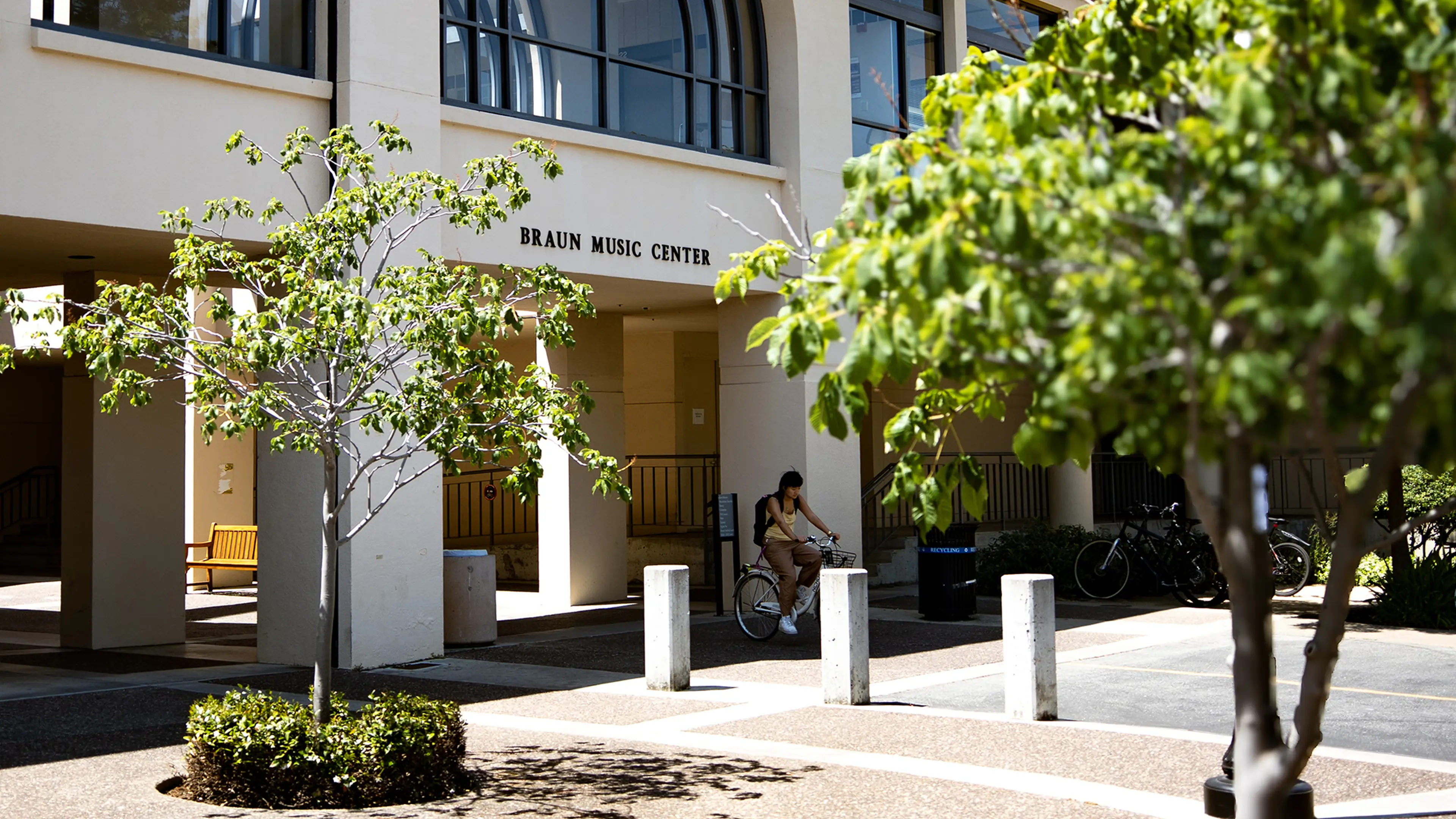
In conjunction with the music theory series, majors must pass an aural skills proficiency examination administered at the end of their junior year. This assesses the ability to transcribe, represent, and reproduce music vocally and on the keyboard, and must be passed before June of the senior year. The exam is scheduled once a year in spring quarter for a date and time in Braun Music Center, announced a few weeks ahead of time by the ear training advisor. Visit the Music website for additional information about ear training.
Writing in the Major (WIM)
WIM Course
Upper Division History Courses (MUSIC 141 - 148) taken for at least four units satisfy the Writing In the Major (WIM) requirement).
MUSIC 117J
Studies in Music, Media, and Popular Culture: The Soul Tradition in African American Music
MUSIC 143F
Nineteenth-Century Pianism: History, Works, & Performance Practices
MUSIC 143J
Studies in Music of the Classical Period: Haydn and Mozart: Music in the Age of Enlightenment
MUSIC 144J
Studies in Music of the Romantic Period: The Faust Legend in Romantic Music
MUSIC 144N
Reading Recorded Performances: From Data to Interpretation
MUSIC 146N
Transcultural Perspectives of South-East Asian Music and Arts
MUSIC 146S
Sound Tracks: Music, Memory, Migration
MUSIC 147Q
Yesterday & Today: The Beatles as History
MUSIC 147R
Performing Rights: Race, Intellectual Property, and the U.S. Recording Industry
MUSIC 147T
This Must Be The Place: American Music and American Geography
MUSIC 147U
Identity, Difference, Sound
Capstone
Capstone Experience
All students will complete a capstone project experience. Most Students will enroll in MUSIC 198, project is determined by subplan field. All composition majors will enroll in MUSIC 198 A/B.
Non-Composition Majors
Enroll for a minimum of two-three units.
MUSIC 198
Concentrations Project
The nature of the capstone project could be research, creativity, or a hybrid of the two. The final format could be the text, presentation, technical demonstration, performance, or a combination.
Instead of 198, the student could count units from MUSIC125 opens in a new tab, MUSIC199 opens in a new tab, and MUSIC220D opens in a new tab.
Recommend taking the 220 series by junior year, having the MUSIC220C opens in a new tab project form the basis of the capstone project, and using senior year to refine, polish, document, and present the work.
Beginning ideally in the junior year, the student should choose one or two advisors and plan regular meetings to develop a topic. It may be appropriate for the project to be co-advised by two faculty members, including one from outside the Department of Music, depending on expertise.
The capstone units can be spread over two or three quarters.
For students graduating in June, the completed project should be presented at least seven days before the grade submission deadline for graduating seniors.
Composition Majors
Enroll for a minimum of 1 unit each.
MUSIC 198A
Capstone Project: Off Stage
MUSIC 198B
Capstone Project: On Stage
In senior year, during the quarter immediately preceding the capstone concert, Composition concentration students should enroll in at least 1 unit of MUSIC 198A for preparation of the capstone.
During the the same quarter as the capstone concert, Composition concentration students should enroll in 1 unit of MUSIC 198B .
Although the capstone project often takes the shape of a senior recital, different outcomes are possible. The capstone project advisor, who must be a Stanford composition faculty member, must approve an abstract or outline of the project. Programmed works may have been created in the context of Stanford music courses or under the supervision of a faculty member. Other works can also be considered, conditional on the approval of the capstone project advisor.
Subplans
RequiredComposition Subplan
Subplan Requirements
Composition Seminar
Enroll in each course for a minimum of one unit
MUSIC 123A
Undergraduate Seminar in Composition: Rhythmic Design
MUSIC 123B
Undergraduate Seminar in Composition: Pitch Design
Orchestration
MUSIC 127A
Instrumentation and Orchestration
MUSIC 127B
Advanced Orchestration
Individual composition lessons
Computer Music
MUSIC 101
Introduction to Creating Electronic Sounds
MUSIC 128
Stanford Laptop Orchestra: Composition, Coding, and Performance
MUSIC 155
Intermedia Workshop
MUSIC 192A
Foundations of Sound-Recording Technology
MUSIC 192C
Session Recording
MUSIC 192F
Sound Installation
MUSIC 220A
Fundamentals of Computer-Generated Sound
MUSIC 220B
Compositional Algorithms, Psychoacoustics, and Computational Music
MUSIC 220C
Research Seminar in Computer-Generated Music
MUSIC 250A
Physical Interaction Design for Music
MUSIC 250C
Interaction - Intermedia - Immersion
MUSIC 256A
Music, Computing, Design: The Art of Design
Concentration Electives
MUSIC 20C
Jazz Arranging and Composition
MUSIC 112
Film Scoring
MUSIC 122A
Counterpoint
MUSIC 122B
Analysis of Tonal Music
MUSIC 122C
Introduction to Post-Tonal Analysis
MUSIC 123C
Undergraduate Seminar in Composition: World Music
MUSIC 124A
Songwriters Workshop
MUSIC 127B
Advanced Orchestration
MUSIC 128
Stanford Laptop Orchestra: Composition, Coding, and Performance
MUSIC 155
Intermedia Workshop
MUSIC 156
"sic": Improvisation Collective
MUSIC 160B
Stanford New Ensemble
MUSIC 161B
Jazz Orchestra
MUSIC 161E
Stanford Afro-Latin Jazz Orchestra
MUSIC 192A
Foundations of Sound-Recording Technology
MUSIC 192C
Session Recording
MUSIC 220A
Fundamentals of Computer-Generated Sound
MUSIC 220B
Compositional Algorithms, Psychoacoustics, and Computational Music
MUSIC 220C
Research Seminar in Computer-Generated Music
MUSIC 250A
Physical Interaction Design for Music
MUSIC 250C
Interaction - Intermedia - Immersion
MUSIC 251
Psychophysics and Music Cognition
MUSIC 256A
Music, Computing, Design: The Art of Design
Conducting Subplan
Subplan Requirements
Complete at least ten units from among the two groups.
Conducting Course
MUSIC 130B
Elementary Instrumental Conducting
MUSIC 130C
Elementary Choral Conducting
MUSIC 136
Intermediate Conducting: Music Since 1900
Advanced Conducting Course
Concentration Theory/Analysis/Ear-Training Requirement
Complete at least five units from among these two groups.
Concentration Theory/Analysis/Ear-Training Requirement
MUSIC 122A
Counterpoint
MUSIC 122B
Analysis of Tonal Music
MUSIC 122C
Introduction to Post-Tonal Analysis
Complete any course not taken to fulfill the Core Requirement.
Concentration Theory/Analysis/Ear-Training Advanced Requirement
Complete this course for at least one unit.
MUSIC 129
Advanced Ear-Training/Musicianship
MUSIC 129 is offered for one or two units. Conducting concentrators must take it for one unit to fulfill the Conducting Concentration requirement but are strongly urged to take it for two units, if possible.
Concentration Performance Requirement
MUSIC 159
Early Music Singers
MUSIC 160
Stanford Symphony Orchestra
MUSIC 160A
Stanford Philharmonia
MUSIC 161A
Stanford Wind Symphony
MUSIC 161B
Jazz Orchestra
MUSIC 162
Symphonic Chorus
MUSIC 163
Memorial Church Choir
MUSIC 165
Chamber Chorale
MUSIC 167
University Singers
MUSIC 171
Chamber Music
Or another ensemble (with advisor’s permission).
Complete three quarters in any combination of these ensembles, one unit per quarter; these Performance units are in addition to the three units that satisfy the Core Breadth Performance requirement.
Music, Science, and Technology (MST) Subplan
Subplan Requirements
Required Courses
MUSIC 220A
Fundamentals of Computer-Generated Sound
MUSIC 220B
Compositional Algorithms, Psychoacoustics, and Computational Music
MUSIC 220C
Research Seminar in Computer-Generated Music
MUSIC 251
Psychophysics and Music Cognition
Enroll in MUSIC 220A, MUSIC 220B, MUSIC 220C for a minimum of three credits per course.
Enroll in MUSIC 251 for a minimum of four units.
Design and Processing Courses
MUSIC 250C
Interaction - Intermedia - Immersion
MUSIC 256A
Music, Computing, Design: The Art of Design
MUSIC 264
Musical Engagement
MUSIC 320
Introduction to Audio Signal Processing
Complete one of the previous for a minimum of four units.
Musicology and Ethnomusicology Subplan
Subplan Requirements
Upper-Level Writing-Intensive Courses
MUSIC 117J
Studies in Music, Media, and Popular Culture: The Soul Tradition in African American Music
MUSIC 143F
Nineteenth-Century Pianism: History, Works, & Performance Practices
MUSIC 143J
Studies in Music of the Classical Period: Haydn and Mozart: Music in the Age of Enlightenment
MUSIC 144J
Studies in Music of the Romantic Period: The Faust Legend in Romantic Music
MUSIC 144N
Reading Recorded Performances: From Data to Interpretation
MUSIC 146N
Transcultural Perspectives of South-East Asian Music and Arts
MUSIC 146S
Sound Tracks: Music, Memory, Migration
MUSIC 147Q
Yesterday & Today: The Beatles as History
MUSIC 147R
Performing Rights: Race, Intellectual Property, and the U.S. Recording Industry
MUSIC 147T
This Must Be The Place: American Music and American Geography
MUSIC 147U
Identity, Difference, Sound
Minimum of 10 units of any upper-level, writing-intensive course, plus relevant courses outside the department, is possible, in consultation with the advisor.
These courses must cover at least two historical periods. At least one of these courses must be taken in the Department of Music.
Concentration Electives
Complete 6 units of concentration electives in any music-related course.
In consultation with the advisor, language courses, too, can count toward concentration electives. Students are strongly encouraged to attain proficiency in at least one language relevant to their research interests.
Musicology and Performance Subplan
Subplan Requirements
Upper-Level Writing Intensive Courses
MUSIC 117J
Studies in Music, Media, and Popular Culture: The Soul Tradition in African American Music
MUSIC 143F
Nineteenth-Century Pianism: History, Works, & Performance Practices
MUSIC 143J
Studies in Music of the Classical Period: Haydn and Mozart: Music in the Age of Enlightenment
MUSIC 144J
Studies in Music of the Romantic Period: The Faust Legend in Romantic Music
MUSIC 144N
Reading Recorded Performances: From Data to Interpretation
MUSIC 146N
Transcultural Perspectives of South-East Asian Music and Arts
MUSIC 146S
Sound Tracks: Music, Memory, Migration
MUSIC 147Q
Yesterday & Today: The Beatles as History
MUSIC 147R
Performing Rights: Race, Intellectual Property, and the U.S. Recording Industry
MUSIC 147T
This Must Be The Place: American Music and American Geography
MUSIC 147U
Identity, Difference, Sound
A minimum of ten units of any upper-level, writing-intensive course, plus relevant courses outside the department, is possible in consultation with the advisor.
These courses must cover at least two historical periods. At least one of these courses must be taken in the Department of Music.
Performance Electives
MUSIC 156
"sic": Improvisation Collective
MUSIC 159
Early Music Singers
MUSIC 160
Stanford Symphony Orchestra
MUSIC 160A
Stanford Philharmonia
MUSIC 160B
Stanford New Ensemble
MUSIC 160C
Stanford Baroque Soloists
MUSIC 160S
Stanford Summer Symphony
MUSIC 161A
Stanford Wind Symphony
MUSIC 161B
Jazz Orchestra
MUSIC 161D
Stanford Brass Ensemble
MUSIC 161E
Stanford Afro-Latin Jazz Orchestra
MUSIC 162
Symphonic Chorus
MUSIC 163
Memorial Church Choir
MUSIC 165
Chamber Chorale
MUSIC 169
Stanford Taiko
MUSIC 171
Chamber Music
MUSIC 172A
Piano
MUSIC 182
Diction for Singers
MUSIC 183A
German Art Song Interpretation
MUSIC 183B
French Art Song Interpretation
MUSIC 183C
Interpretation of Musical Theater Repertoire
MUSIC 183E
Singing for Musicals
MUSIC 184A
Editing and Performing Early Music
MUSIC 184B
Topics on the Musical Stage
MUSIC 184C
Dramatic Vocal Arts: Songs and Scenes Onstage
MUSIC 272A
Piano for Music Majors/Minors
In consultation with the advisor, the student can choose any performance course. Students are strongly encouraged to attain proficiency in at least one language relevant to their research interests. From September 2024 going forward, all private music lessons are cataloged with a 100-level number.
Performance in Keyboard Studies Subplan
Solo and Ensemble Techniques
Private lessons
MUSIC 172A
Piano
MUSIC 172B
Organ
MUSIC 172C
Harpsichord
MUSIC 272A
Piano for Music Majors/Minors
MUSIC 272B
Organ for Music Majors/Minors
MUSIC 272C
Harpsichord for Music Majors/Minors
Complete six quarters for at least one unit per quarter. Performance concentrators must earn required private lesson credits through enrollment in private lesson sections taught by Stanford Department of Music faculty members.
Small, unconducted ensemble
MUSIC 171
Chamber Music
Enroll a minimum of three times.
Thoroughbass
MUSIC 126A
Thoroughbass Accompaniment
Solo and Ensemble Techniques
MUSIC 160C
Stanford Baroque Soloists
MUSIC 170
Collaborative Piano
MUSIC 183A
German Art Song Interpretation
MUSIC 183B
French Art Song Interpretation
Aural and analytical skills especially pertinent to performance
MUSIC 122D
Analysis for Performance
MUSIC 129K
Advanced Keyboard Musicianship
Awareness of repertoire and cultural history
MUSIC 155A
Piano Literature
Enroll a minimum of three times.
Performance in String Studies Subplan
Solo and Ensemble Techniques
Private lessons
MUSIC 174A
Violin
MUSIC 174B
Viola
MUSIC 174C
Violoncello
MUSIC 174D
Contrabass
MUSIC 174G
Harp
MUSIC 174I
Jazz Bass
MUSIC 174J
Jazz & Contemporary Guitar
MUSIC 274A
Violin for Music Majors/Minors
MUSIC 274B
Viola for Music Majors/Minors
MUSIC 274C
Violoncello for Music Majors/Minors
MUSIC 274D
Contrabass for Music Majors/Minors
MUSIC 274G
Advanced Harp
MUSIC 274I
Jazz Bass for Music Majors/Minors
MUSIC 274J
Jazz & Contemporary Guitar for Music Majors/Minors
Complete six quarters for at least one unit per quarter. Performance concentrators must earn required private lesson credits through enrollment in private lesson sections taught by Stanford Department of Music faculty members.
Chamber Music
MUSIC 171
Chamber Music
Complete six quarters. Chamber Music refers to a small, unconducted ensemble. Up to two units in MUSIC 160B or MUSIC 160C may also apply toward the Chamber Music requirement.
Aural and analytical skills especially pertinent to performance
MUSIC 122D
Analysis for Performance
MUSIC 129
Advanced Ear-Training/Musicianship
Large, conducted ensemble
MUSIC 160
Stanford Symphony Orchestra
MUSIC 160A
Stanford Philharmonia
Performance in Vocal Studies Subplan
Solo and Ensemble Techniques
Private Lessons
Complete six quarters for at two units per quarter. Performance concentrators must earn required private lesson credits through enrollment in private lesson sections taught by Stanford Department of Music faculty members.
Voice Repertoire: Aural and analytical skills especially pertinent to performance
MUSIC 182
Diction for Singers
MUSIC 183A
German Art Song Interpretation
MUSIC 183B
French Art Song Interpretation
MUSIC 183C
Interpretation of Musical Theater Repertoire
Complete two courses for one unit among the previous.
Voice Repertoire: Voice Pedagogy
MUSIC 183H
Vocal Pedagogy
Voice Repertoire: Vocal Stage Performance
MUSIC 184A
Editing and Performing Early Music
MUSIC 184B
Topics on the Musical Stage
MUSIC 184C
Dramatic Vocal Arts: Songs and Scenes Onstage
Complete one course for two units among the previous.
Performance in Woodwind, Brass, and Percussion Studies Subplan
Solo and Ensemble Techniques
Solo Technique
MUSIC 175A
Flute
MUSIC 175B
Oboe
MUSIC 175C
Clarinet
MUSIC 175D
Bassoon
MUSIC 175F
Saxophone
MUSIC 175G
Baroque Flute
MUSIC 175H
Jazz Saxophone
MUSIC 176A
French Horn
MUSIC 176B
Trumpet
MUSIC 176D
Tuba
MUSIC 176E
Jazz Trumpet
MUSIC 177
Percussion
MUSIC 177A
Drum Set Lessons
MUSIC 275A
Flute for Music Majors/Minors
MUSIC 275B
Oboe for Music Majors/Minors
MUSIC 275C
Clarinet for Music Majors/Minors
MUSIC 275D
Bassoon for Music Majors/Minors
MUSIC 275F
Saxophone for Music Majors/Minors
MUSIC 275G
Baroque Flute for Music Majors/Minors
MUSIC 276A
French Horn for Music Majors/Minors
MUSIC 276B
Trumpet for Music Majors/Minors
MUSIC 276C
Trombone for Music Majors/Minors
MUSIC 276D
Tuba for Music Majors/Minors
MUSIC 276E
Jazz Trumpet for Music Majors/Minors
MUSIC 277
Percussion for Music Majors/Minors
MUSIC 277A
Drum Set for Music Majors/Minors
Complete six quarters for one unit per quarter. Performance concentrators must earn required private lesson credits through enrollment in private lesson sections taught by Stanford Department of Music faculty members.
Ensemble technique
MUSIC 160
Stanford Symphony Orchestra
MUSIC 160A
Stanford Philharmonia
MUSIC 160B
Stanford New Ensemble
MUSIC 161A
Stanford Wind Symphony
MUSIC 161B
Jazz Orchestra
MUSIC 161D
Stanford Brass Ensemble
Chamber Music
MUSIC 171
Chamber Music
Analysis Skills for Performance

MUSIC 122D
Analysis for Performance
Theory Subplan
Subplan Requirements
Additional Upper Division Analysis
MUSIC 122A
Counterpoint
MUSIC 122B
Analysis of Tonal Music
MUSIC 122C
Introduction to Post-Tonal Analysis
Musicanship
MUSIC 126A
Thoroughbass Accompaniment
MUSIC 127A
Instrumentation and Orchestration
MUSIC 129
Advanced Ear-Training/Musicianship
MUSIC 129K
Advanced Keyboard Musicianship
Performance Practice
MUSIC 184A
Editing and Performing Early Music
MUSIC 251
Psychophysics and Music Cognition
MUSIC 269
Research in Performance Practices
Complete one course for at least three units from among the previous.
Concentration Electives
Self-Designed Subplan
Focus Area Courses
Take 16 units in a focal area in consultation with the Program Advisor.
The self-designed music major allows students to choose courses beyond the shared 42-unit core. They develop a focus area in consultation with the Program Advisor. They are allocated 16 units toward courses in this focus area; the remaining four units are reserved for the capstone project (see below). If necessary for the focus area, three of the 16 units may be taken outside the Music Department, with the permission of the advisor. Focus areas may center on courses in established areas of the department for which there is no existing subplan (e.g., jazz, musical theater), or they may delineate a path that moves across different programs within the department. Focal areas may have a creative or critical emphasis or a blended approach. The 16 units in the focus area should provide a spur and grounding for the four-unit capstone project.
Honors
OptionalHonors
Honors Overview
The faculty awards honors in music to majors who have produced an independent project of exceptional quality through a concentration. To receive honors, students must also have earned an overall GPA of 3.6 or higher and a GPA of 3.7 or higher in courses required for the Music major. Honors are conferred through faculty adjudication. For students concentrating in multiple areas, a single jury is convened.