
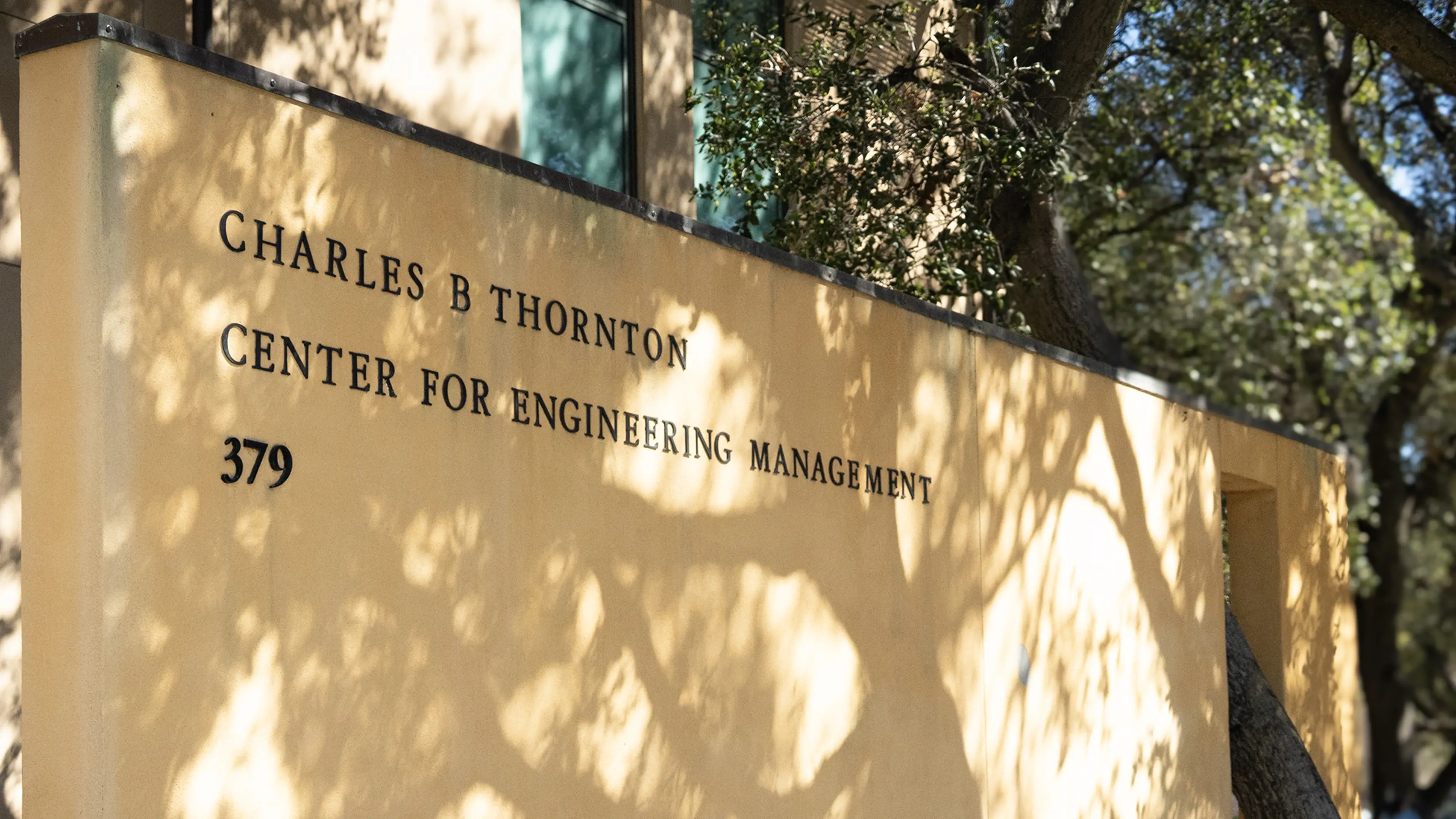
Major: Bachelor of Science
MajorOverview
The bachelor's degree in Mechanical Engineering at Stanford University provides a rigorous mathematical, scientific, and engineering education, preparing our students to analyze and design a wide range of mechanical systems. Students study topics in math, physics, materials, structures, fluid mechanics, thermodynamics, heat transfer, dynamical systems, control, and design methods. They use these tools to develop analytical and computational models of real-world systems, conduct experiments and interpret their findings, and design new systems to meet engineering specifications.
Students with a bachelor's degree in Mechanical Engineering go on to rewarding careers as engineers in industry or pursue further study as graduate students. Our recent graduates are making important contributions in advanced manufacturing, aviation, biomechanics, data science, defense, energy systems, healthcare, medical devices, renewable energy, robotics, transportation systems, sustainable agriculture, and related fields. Whatever field they choose, Mechanical Engineers from Stanford have the intellectual foundation to develop technologies that address societal needs and improve people's lives.
Please see the Mechanical Engineering Program Sheet opens in a new tab, Four-Year Plans, and Flowchart opens in a new tab for additional information and materials.
Requirements
School Requirements
Mathematics
The program requires a minimum of 45 units of math and science combined, including 24 units in math and 20 units in science. The 45th unit may be either math or science. ACE units do not count toward major program unit minimums, though they do count toward the 180-unit minimum needed for graduation.
The CME courses in mathematics are strongly preferred for ME majors.
Calculus
10 units of AP Calculus BC, with placement into MATH 51/CME 100, is equivalent to MATH 19/MATH 20/MATH 21 and acceptable in any engineering major. If 6-8 units of AP or IB credit are given, MATH 21 must be taken regardless of the Math Diagnostic Placement results.
Recommended Timeline: Taken in the 1st year.

Ordinary Differential Equations
Recommended Timeline: Taken in Autumn of the 2nd year or earlier.
Additional Math Courses
Additional courses from the School of Engineering's approved Math course list for 2026-27 to reach the 24-unit minimum of Math coursework, and/or the 45-unit minimum for Math and Science. The list is available in the Mathematics and Statistics subsection within the Engineering-BS School Requirements.
Science
The program requires a minimum of 45 units of math and science combined, including 20 units in science and 24 units in math. The 45th unit may be either math or science. ACE units do not count toward major program unit minimums, though they do count toward the 180-unit minimum needed for graduation.
Mechanics
PHYSICS 41
Mechanics
PHYSICS 41E
Mechanics, Concepts, Calculations, and Context
PHYSICS 61
Mechanics and Special Relativity
A score of 5 on the AP Physics C Mechanics exam may be used to satisfy this requirement. AP credits can only be applied if the parallel Stanford courses are skipped.
Recommended Timeline: Taken by Autumn of the 2nd year.
Electricity and Magnetism
PHYSICS 43
Electricity and Magnetism
PHYSICS 81
Electricity and Magnetism Using Special Relativity and Vector Calculus
A score of 5 on the AP Physics C Electricity & Magnetism exam may be used to satisfy this requirement. AP credits can only be applied if the parallel Stanford courses are skipped.
Recommended Timeline: Taken by Winter of the 2nd year.
Additional Science Courses
Additional courses from the School of Engineering's approved Science course list for 2026-27 to reach the 20-unit minimum of Science coursework, and/or the 45-unit minimum for Math and Science. The list is available in the Mathematics and Statistics subsection within the Engineering-BS School Requirements.
AP Physics 1&2 and Physics 20 courses are not allowed as science units.
Technology in Society (TiS)
AA 252
Techniques of Failure Analysis
BIOE 131
Ethics in Bioengineering
COMM 120W
The Rise of Digital Culture
CS 181
Computers, Ethics, and Public Policy
ENERGY 177A
Engineering and Sustainable Development: Toolkit

ENERGY 177B
Engineering and Sustainable Development: Implementation
HUMBIO 174
Foundations of Bioethics
Depth in Discipline
Mechanical Engineering Depth
The following core courses provide students with a depth in Mechanical Engineering, covering topics in:
Computational and Experimental Synthesis
Design and Manufacturing
Structures, Dynamics, and Control
Thermodynamics, Fluids, and Heat Transfer
Courses must be taken in prerequisite order. The recommended timeline for each course can be found on the latest program sheet opens in a new tab.
ENGR 15
Dynamics
ME 30
Engineering Thermodynamics
ME 70
Introductory Fluids Engineering
ME 80
Mechanics of Materials
ME 102
Foundations of Product Realization
ME 103
Product Realization: Design and Making
ME 104
Mechanical Systems Design
ME 123
Computational Engineering
ME 131
Heat Transfer
ME 149
Mechanical Measurements
ME 161
Dynamic Systems, Vibrations and Control
ME 170A
Mechanical Engineering Design- Integrating Context with Engineering
ME 170B
Mechanical Engineering Design: Integrating Context with Engineering
Electives
Technical Electives
The program requires a minimum of 12 units of Technical Electives from the following list. If needed, additional units must be taken to fulfill the 68-unit minimum in Engineering Topics (Fundamentals, ME Depth, and Technical Electives). Students are encouraged to review "Course Recommendations" on the latest program sheet for courses well-aligned with various career plans.
AA 103
Air and Space Propulsion
AA 156
Introduction to Mechanics of Composite Materials
AA 174B
Principles of Robot Autonomy II
AA 222
Engineering Design Optimization
AA 274A
Principles of Robot Autonomy I
AA 283
Aircraft and Rocket Propulsion
BIOE 209
Mathematical Modeling of Biological Systems
CME 192
MATLAB for Scientific Computing and Engineering
DESIGN 223
Silver Pendant Project
DESIGN 298
Silversmithing and Design
ENGR 40M
An Intro to Making: What is EE
ENGR 105
Feedback Control Design
ENGR 205
Introduction to Control Design Techniques
ENGR 240
Introduction to Micro and Nano Electromechanical Systems
MATSCI 144
Thermodynamic Evaluation of Green Energy Technologies
MATSCI 151
Microstructure and Mechanical Properties
MATSCI 198
Mechanical Properties of Materials
ME 80A
Introduction to Deformable Bodies
ME 128
Computer-Aided Product Realization
ME 129
Manufacturing Processes and Design
ME 132
Intermediate Thermodynamics
ME 133
Intermediate Fluid Mechanics
ME 152
Material Behaviors and Failure Prediction
ME 170C
Mechanical Engineering Design - Integrating Context with Engineering III
ME 204
Advanced Mechanical Systems Design
ME 210
Introduction to Mechatronics
ME 217
Engineering Design Analytics for Product Realization
ME 220
Introduction to Sensors
ME 234
Introduction to Neuromechanics
ME 235
Biotransport Phenomena
ME 257
Gas-Turbine Design Analysis
ME 281
Biomechanics of Movement
ME 283
Introduction to Biomechanics and Mechanobiology
ME 285
Computational Modeling in the Cardiovascular System
ME 287
Mechanics of Biological Tissues
ME 300C
Introduction to Numerical Methods for Engineering
ME 303
Soft Composites and Soft Robotics
ME 320
Introduction to Robotics
ME 327
Design and Control of Haptic Systems
ME 331A
Advanced Dynamics & Computation
ME 335A
Finite Element Analysis
ME 338
Continuum Mechanics
ME 339
Introduction to parallel computing using MPI, openMP, and CUDA
ME 351A
Fluid Mechanics
ME 351B
Fluid Mechanics
ME 352B
Fundamentals of Heat Conduction
ME 352C
Convective Heat Transfer
ME 362A
Physical Gas Dynamics
ME 370A
Energy Systems I: Thermodynamics
ME 371
Combustion Fundamentals
ME 485
Modeling and Simulation of Human Movement
PHYSICS 240
Introduction to the Physics of Energy
Only 3 units in total from DESIGN 223 and/or DESIGN 298 can be counted towards the Technical Electives requirement.
Only 3 units in total from ME 170C and/or ME 191 can be counted towards the Technical Electives requirement.
ME 191 units may only be used to satisfy the Technical Electives requirement if successfully petitioned in advance. Petitions must include a detailed study plan with deliverables and must demonstrate approval by the independent study supervisor.
Writing in the Major (WIM)
Honors
OptionalHonors
Honors Overview
Honors programs are designed to allow undergraduates with strong academic records and enthusiasm for independent research to engage in a significant project leading to a degree with departmental honors. This option is particularly valuable for students who plan to pursue a PhD because it provides research experience that helps prepare for doctoral-level work. These programs require that the student find a faculty member from the Academic Council in the School of Engineering to supervise the work, in addition to a second reader.
The Department of Mechanical Engineering offers a program leading to a Bachelor of Science in Mechanical Engineering with Honors opens in a new tab. This program provides a unique opportunity for qualified mechanical engineering majors to conduct independent study and research at an advanced level with a faculty mentor.
Honors Criteria
GPA of 3.5 or higher in the major
Arrangement with an ME faculty member who agrees to be the thesis advisor; the advisor must be a member of the Academic Council
Apply no later than the end of the second week of the autumn quarter of your senior year
To receive departmental honors, students admitted to the honors program must, in addition to satisfying the standard requirements for the undergraduate degree, do the following:
Declare the honors program in Axess
Maintain a 3.5 GPA in the major required for admission to the honors program
Under the direction of the thesis advisor, complete at least nine units of ME 191H during the senior year
Complete an honors thesis deemed acceptable by the thesis advisor and at least one additional faculty member
Honors Required Course
ME 191H
Honors Research