Bulletin

Interested in attending Stanford?
Visit Undergraduate Admissions opens in a new tab or Graduate Admissions opens in a new tab.

Resources

  • About Stanford
  • About Bulletin
  • Academic Calendar opens in a new tab
  • Bulletin Archive
  • Enrollment Overview opens in a new tab
  • Enrollment Deadlines opens in a new tab
  • Degrees at a Glance

Schools

  • Doerr School of Sustainability opens in a new tab
  • Graduate School of Business opens in a new tab
  • Graduate School of Education opens in a new tab
  • School of Engineering opens in a new tab
  • School of Humanities and Science opens in a new tab
  • School of Law opens in a new tab
  • School of Medicine opens in a new tab
Give Feedback

Stanford University is accredited by the Accrediting Commission of Senior Colleges and Universities of the Western Association of Schools and Colleges opens in a new tab.

Give Feedback
Stanford
University
  • Stanford Home
  • Maps & Directions
  • Search Stanford
  • Emergency Info
  • Terms of Use
  • Privacy
  • Copyright
  • Trademarks
  • Non-Discrimination
  • Accessibility
© Stanford University.  Stanford, California 94305.
Skip to main content
Stanford University
Bulletin
Chemical Engineering
School of Engineering
  • Major
  • Minor
Program Info
  • About the Program
  • Major: Bachelor of Science
    • Policies
    • Learning Outcomes
  • Minor
  • Courses
  • Contact Us
Undergrad Info
  • Admissions
  • Advising
  • General Education
Loading program
  1. Home
  2. Programs
  3. Undergraduate
  4. Chemical Engineering
  5. Major: Bachelor of Science

Major: Bachelor of Science

Major
  • Chemical Engineering opens in a new tab
Program Minimum Units
95 Units
University Minimum Units
180 Units
Interests
Ecology & Environment, Public Health, Sustainability, Technology
Academic Areas
Engineering & Computer Science, Sustainability

Overview

Chemical engineers are responsible for the conception and design of processes for producing, transforming, and transporting materials. This activity begins with experimentation in the laboratory and is followed by implementing the technology in full-scale production. The undergraduate program in Chemical Engineering aims to develop students’ understanding of the core scientific, mathematical, and engineering principles that serve as the foundation underlying these technological processes. The program’s core mission is reflected in its curriculum, which is built on a foundation in the sciences of chemistry, physics, and biology. Coursework includes the study of applied mathematics, material and energy balances, thermodynamics, fluid mechanics, energy and mass transfer, separations technologies, chemical reaction kinetics and reactor design, and process design. The program provides students with excellent preparation for careers in the corporate sector and government or for graduate study.

Requirements

School Requirements

Mathematics

Complete a minimum of 15 units of Math coursework.

Complete all of the following requirements:
Calculus
Complete all of the following course(s):
MATH 19

Calculus

3 Units
MATH 20

Calculus

3 Units
MATH 21

Calculus

4 Units

Relevant AP credit may also be used. Please see the Stanford External Test Credit Equivalency Charts for additional details.

and
Additional Calculus

Students must complete either CME 100, or Math 51 and 52.

Complete at least 1 of the following courses:
CME 100

Vector Calculus for Engineers

5 Units
MATH 51

Linear Algebra, Multivariable Calculus, and Modern Applications

5 Units
and
MATH 52

Integral Calculus of Several Variables

5 Units

Science

Complete a minimum of 23 units of Science coursework.

Complete all of the following course(s):
CHEM 31E

Chemical Foundations and 21st Century Problems

5 Units
CHEM 33

Structure and Reactivity of Carbon-Based Molecules

5 Units
CHEM 121

Understanding the Natural and Unnatural World through Chemistry

5 Units
PHYSICS 41

Mechanics

4 Units
or
PHYSICS 41E

Mechanics, Concepts, Calculations, and Context

5 Units
or
PHYSICS 61

Mechanics and Special Relativity

4 Units
PHYSICS 43

Electricity and Magnetism

4 Units
or
PHYSICS 81

Electricity and Magnetism Using Special Relativity and Vector Calculus

4 Units

Relevant AP credit may also be used. Please see the Stanford External Test Credit Equivalency Charts for additional details.

Technology in Society (TiS)

Students must complete at least one course of at least 3 units or more from the School of Engineering's approved Technology in Society list for 2026-27. The list is available in the Technology in Society subsection within the Engineering-BS School Requirements.


TiS course must be on the list the year that they are taken.

Engineering Fundamentals

Complete all of the following course(s):
CHEMENG 20

Introduction to Chemical Engineering

4 Units
CHEMENG 55

Foundational Biology for Engineers

4 Units

Depth in Discipline

Chemical Engineering Depth

Complete a minimum of 46 units of Depth Coursework.

CHEMENG 185A will also satisfy the Writing in the Major (WiM) requirement, and CHEMENG 185B will also satisfy the Capstone requirement.

Complete all of the following course(s):
CHEMENG 105A

Applied Mathematics in Chemical Engineering A

4 Units
CHEMENG 105B

Applied Mathematics in Chemical Engineering B

4 Units
CHEMENG 110A

Introduction to Chemical Engineering Thermodynamics

4 Units
CHEMENG 110B

Statistical and Multi-Component Thermodynamics

4 Units
CHEMENG 120A

Fluid Mechanics

4 Units
CHEMENG 120B

Energy and Mass Transport

4 Units
CHEMENG 130A

Microkinetics - Molecular Principles of Chemical Kinetics

4 Units
CHEMENG 130B

Introduction to kinetics and reactor design

4 Units
CHEMENG 180

Chemical Engineering Plant Design

4 Units
CHEMENG 185A

Chemical Engineering Laboratory A

5 Units
CHEMENG 185B

Chemical Engineering Laboratory B

5 Units

Students who completed CHEMENG 100 before academic year 2026/2027 may substitute CHEMENG 105A with CHEMENG 100.
Students who completed CHEMENG 105 before academic year 2026/2027 may substitute CHEMENG 105B with CHEMENG 105.

Writing in the Major (WIM)

Writing in the Major (WIM)

The Writing in the Major (WiM) requirement will satisfy upon completion of CHEMENG 185A taken as part of the Chemical Engineering Depth required coursework.

Complete all of the following course(s):
CHEMENG 185A

Chemical Engineering Laboratory A

5 Units

Capstone

Course Requirement

The Capstone requirement will satisfy upon completion of CHEMENG 185B taken as part of the Chemical Engineering Depth required coursework.

Complete all of the following course(s):
CHEMENG 185B

Chemical Engineering Laboratory B

5 Units

Honors

Optional
Students may choose to pursue department honors by completing a program of special advanced work, such as an honors thesis, in addition to their major requirements.

Honors

Honors Requirements Overview

This program offers an opportunity for undergraduate majors with a GPA of 3.5 or higher to undertake research at an advanced level with a faculty mentor, graduate students, and other undergraduates. This three-quarter sequential program involves (1) submission of a research proposal for faculty review, (2) appropriate faculty approvals, (3) enrollment in the undergraduate honors seminar CHEMENG 191H opens in a new tab, (4) in-depth research over a minimum of three quarters, (5) completion of a faculty-approved thesis, and (6) participation in the Chemical Engineering Honors Symposium held annually during the Mason Lecture Series, Spring Quarter. The last requirement may also be fulfilled through an alternative, public, oral presentation with the approval of the department chair. Work should begin a minimum of four quarters prior to graduation.

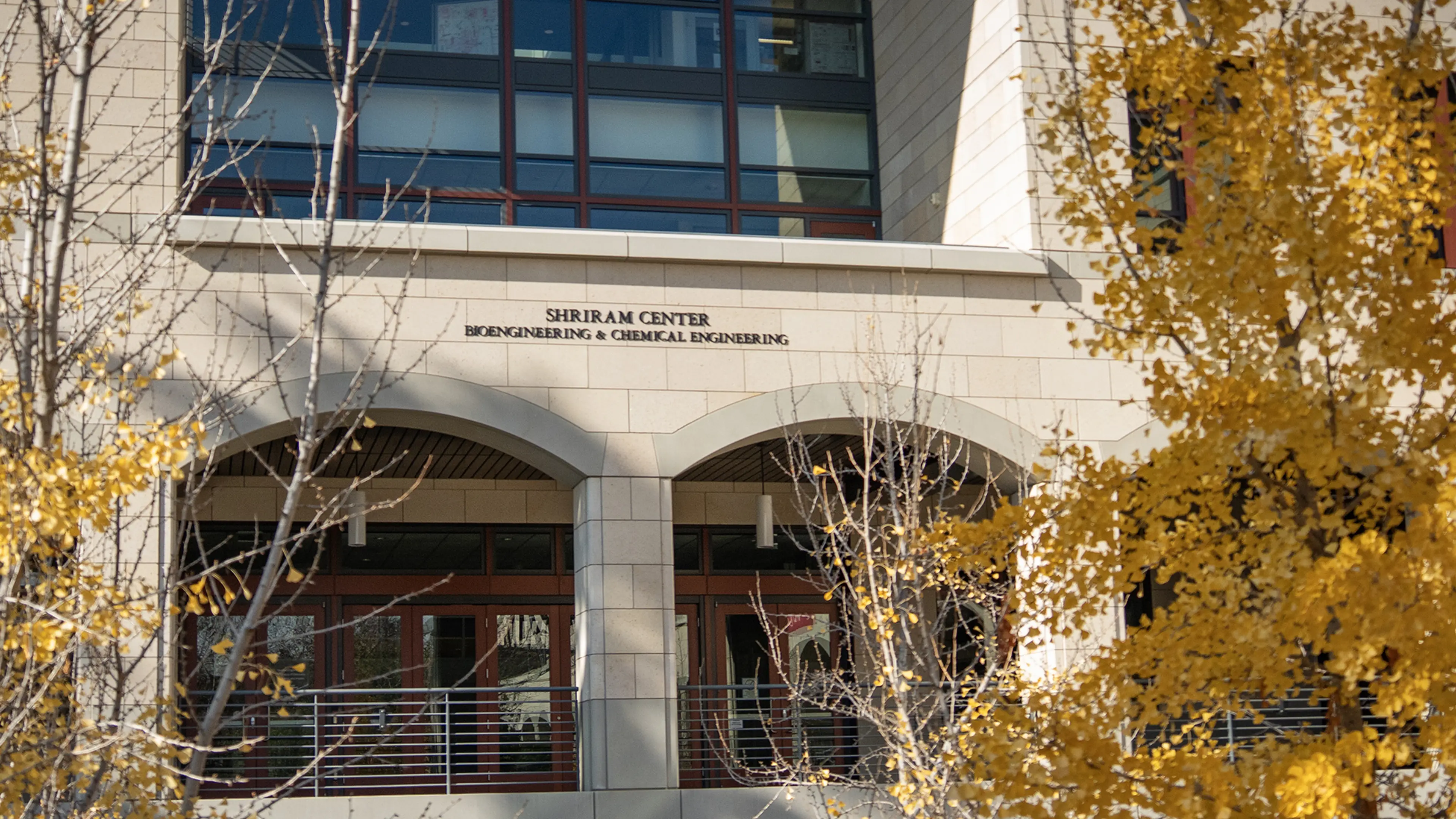
Chemical engineering majors who wish to be considered for the honors program should see departmental student services in Shriram Center, room 129, no later than the beginning of Winter Quarter of their junior year for more information about the application process, for a research proposal template, and for other assistance. The 2026-2027 deadline is March 05, 2027. (Winter Quarter of the junior year), and must include a proposal describing the research project, a transcript of courses taken at Stanford, and endorsement by both the student’s research thesis adviser and a faculty reader. The research adviser or the reader or, alternatively, a faculty sponsor, must be a faculty member in the Department of Chemical Engineering. A faculty review committee will select the successful candidates. To qualify for departmental recommendation for the degree of Bachelor of Science in Chemical Engineering with Honors, degree students must:

  1. Maintain an overall GPA of 3.5 or higher as calculated on the unofficial transcript.

  2. Complete at least three quarters of research with a minimum of 10 hours per week for 3 total quarters of research in Chemical Engineering as either CHEMENG 190H opens in a new tab enrollment (9 units total) or as an Undergraduate Research Assistant at the discretion of the sponsoring faculty member. All quarters must focus on the same topic. Maintain the same faculty advisor and faculty reader throughout, if feasible.

  3. Enroll in CHEMENG 191H opens in a new tab, Undergraduate Honors Seminar

  4. Participate with a poster and oral presentation of thesis work at the Chemical Engineering Honors Poster Session held during the Mason Lectures week, Spring Quarter, or, at the Undergraduate Program Committee’s discretion, at a comparable public event. Submit at the same time to student services one copy of the poster in electronic format.

  5. Submit final drafts of a thesis simultaneously to both the advisor and the reader and, if appropriate, to the Chemical Engineering faculty sponsor, no later than April 5, 2027 (or the first school day of the second week of the quarter in which the degree is to be conferred).

  6. Complete all work and thesis revisions and obtain indicated faculty approvals on the Certificate of Final Reading of Thesis forms by April 30, 2027, or end of the first month of the graduation quarter.

  7. Submit to departmental student services the final copy of the honors thesis in electronic format, as approved by the appropriate faculty. Include an original, completed, faculty signature sheet immediately following the title page. The 2026-2027 deadline is May 3, 2027.

All requirements for the honors program are in addition to the normal undergraduate program requirements.

Undergraduate Honors Research in Chemical Engineering 

Complete at least three quarters of research with an aggregate enrollment of a minimum of nine units in CHEMENG 190H Undergraduate Honors Research in Chemical Engineering for a letter grade; up to three units may be used towards the Chemical Engineering depth elective requirements. All quarters must focus on the same topic. The same faculty advisor and faculty reader should be maintained throughout if feasible.

Earn at least 9 units in the following course(s):
CHEMENG 190H

Undergraduate Honors Research in Chemical Engineering

1-5 Units

Undergraduate Honors Seminar

Enroll in CHEMENG 191H Undergraduate Honors Seminar, concurrently with each quarter of enrollment in CHEMENG 190H Undergraduate Honors Research in Chemical Engineering.

Earn at least 3 units in the following course(s):
CHEMENG 191H

Undergraduate Honors Seminar

1 Units