
Bulletin

Interested in attending Stanford?
Visit Undergraduate Admissions opens in a new tab or Graduate Admissions opens in a new tab.

Resources

  • About Stanford
  • About Bulletin
  • Academic Calendar opens in a new tab
  • Bulletin Archive
  • Enrollment Overview opens in a new tab
  • Enrollment Deadlines opens in a new tab
  • Degrees at a Glance

Schools

  • Doerr School of Sustainability opens in a new tab
  • Graduate School of Business opens in a new tab
  • Graduate School of Education opens in a new tab
  • School of Engineering opens in a new tab
  • School of Humanities and Science opens in a new tab
  • School of Law opens in a new tab
  • School of Medicine opens in a new tab
Give Feedback

Stanford University is accredited by the Accrediting Commission of Senior Colleges and Universities of the Western Association of Schools and Colleges opens in a new tab.

Give Feedback
Stanford
University
  • Stanford Home
  • Maps & Directions
  • Search Stanford
  • Emergency Info
  • Terms of Use
  • Privacy
  • Copyright
  • Trademarks
  • Non-Discrimination
  • Accessibility
© Stanford University.  Stanford, California 94305.
Skip to main content
Stanford University
Bulletin
Physics
School of Humanities & Sciences
  • MS
  • PhD
  • PhD Minor
Program Info
  • About the Program
  • Master of Science
  • Doctor of Philosophy
    • Admissions
    • Advising
    • Policies
    • Learning Outcomes
  • PhD Minor
  • Courses
  • Contact Us
Loading program
  1. Home
  2. Programs
  3. Graduate
  4. Physics
  5. Doctor of Philosophy

Doctor of Philosophy

PhD
  • Physics opens in a new tab
Program Minimum Units
135 Units
University Minimum Units
135 Units
Program Length
6 Years
Interests
Data and Information Sciences, Experimentation & Discovery, Technology
Academic Areas
Education, Natural Sciences, Mathematics & Data Sciences

Overview

The department of physics offers opportunities for graduate coursework and research in both experimental and theoretical physics, studying natural phenomena from the smallest scales of particle physics to the largest of cosmology. Active research areas include accelerator physics, astrophysics, condensed matter, cosmology, particle physics, quantum information and quantum optics, among others. Departmental faculty members, as well as members of other departments including, but not limited to, Applied Physics, Biology, Electrical Engineering, Materials Science & Engineering, Particle Physics & Astrophysics at SLAC, and Photon Science at SLAC participate in supervising student research.

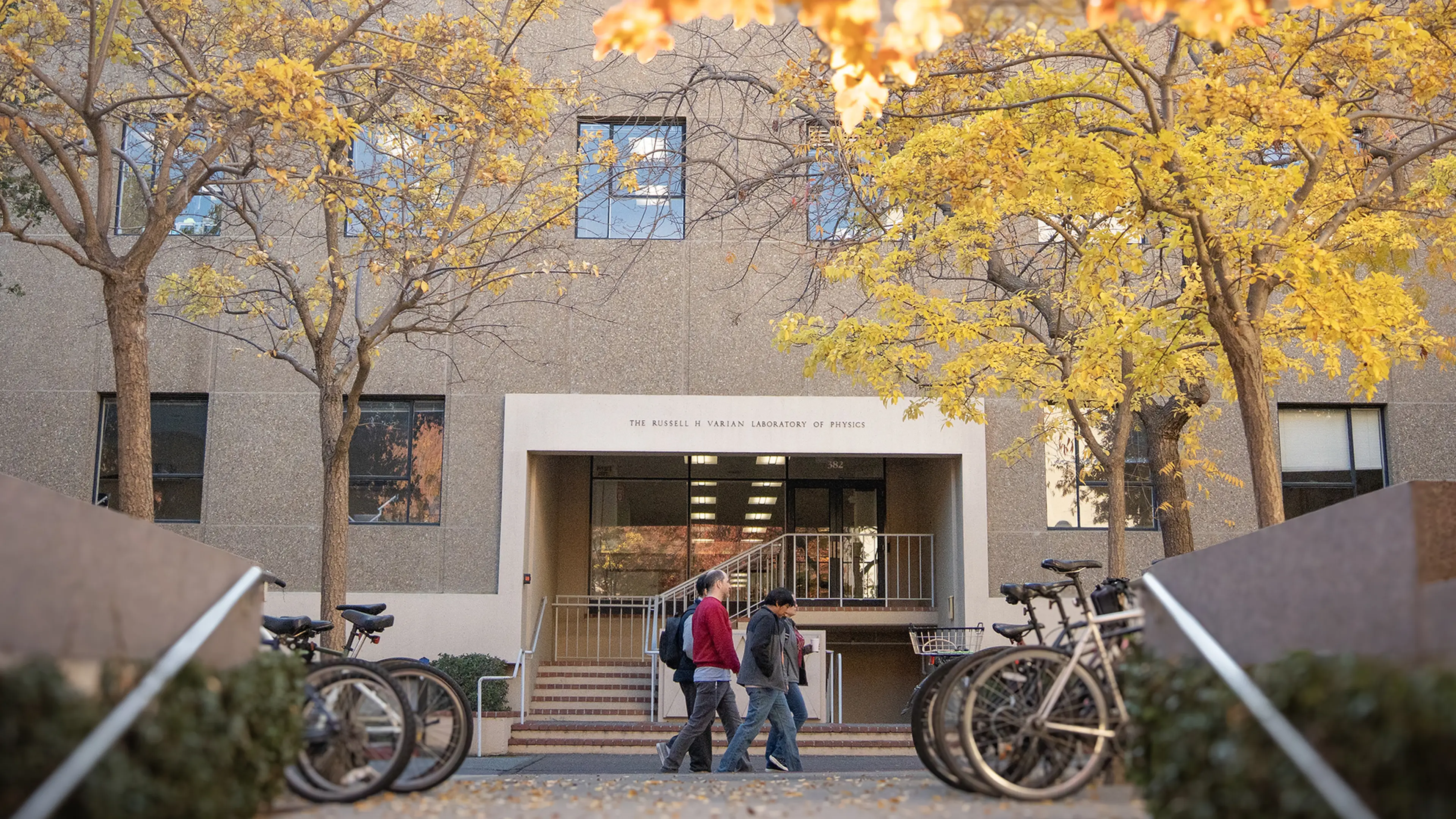
The Russell H. Varian Laboratory of Physics, the Physics and Astrophysics Building, the W. W. Hansen Experimental Physics Laboratory (HEPL), the E. L. Ginzton Laboratory, the Center for Nanoscale Science and Engineering and the Geballe Laboratory for Advanced Materials (GLAM) together house a range of physics activities from general courses through advanced research. Ginzton Lab houses research on optical systems, including quantum electronics, metrology, optical communication, and the development of advanced lasers. GLAM houses research on novel and nanopatterned materials, from high-temperature superconductors and magnets to organic semiconductors, subwavelength photon waveguides, and quantum dots. GLAM also supports the materials community on campus with various characterization tools: it is the Stanford Nanocharacterization Lab (SNL) site and the NSF-sponsored Center for Probing the Nanoscale (CPN). The SLAC National Accelerator Laboratory is just a few miles from the Varian Laboratory. SLAC is a national laboratory funded by the Offices of Basic Energy Sciences and High Energy Physics of the Department of Energy. Scientists at SLAC conduct research in photon science, accelerator physics, particle physics, astrophysics, and cosmology. The laboratory hosts a two-mile-long linear accelerator that can accelerate electrons and positrons. The Stanford Synchrotron Radiation Light Source (SSRL) uses intense X-ray beams produced with a storage ring on the SLAC site. The Linac Coherent Light Source (LCLS), completed in 2009, is the world’s first x-ray free-electron laser and has opened new avenues of research in ultra-fast photon science.

The Kavli Institute for Particle Astrophysics and Cosmology (KIPAC), formed jointly with the SLAC National Accelerator Laboratory, provides a focus for theoretical, computational, observational, and instrumental research programs. A wide range of research areas in particle astrophysics and cosmology are investigated by students, postdocs, research staff, and faculty. KIPAC is heavily involved in two significant projects: the Fermi Gamma-Ray Space Telescope (FGST) and the Large Synoptic Survey Telescope (LSST). KIPAC members also participate fully in the Cryogenic Dark Matter Search (CDMS), the Solar Dynamics Observatory (SDO), the EXO-200 double beta decay experiment, the Dark Energy Survey (DES), the NuSTAR and Astro-H X-ray satellites, and several cosmic microwave background experiments (BICEP, KECK, QUIET, and POLAR-1).

The Leinweber Institute for Theoretical Physics at Stanford is devoted to investigating the basic structure of matter and the universe, including condensed matter physics, particle theory, quantum cosmology, quantum information, and string & M-theory.

This program is full time, doctoral students in the Physics PhD program are expected to maintain a significant physical presence on campus throughout their graduate studies. This ensures that students have access to advisors and mentors, libraries, and other resources that support timely progress towards completion of degree requirements. Additionally, being on campus ensures that students are part of the academic and campus community which supports continued professional development.

While not formal requirements, all PhD candidates are expected to have math proficiency equivalent to the following Stanford MATH courses:

Course List

Units

MATH 106

Functions of a Complex Variable

3

MATH 113

Linear Algebra and Matrix Theory

3

MATH 116

Complex Analysis

3

PHYSICS 111

Partial Differential Equations of Mathematical Physics

4

PHYSICS 112

Mathematical Methods for Physics

4

Requirements

Program Requirements

Requirements Overview

The department requirements for the PhD degree in Physics consist of completing all courses listed below and fulfilling the Breadth Requirement. Students must complete at least one course from each of two subject areas outside the student’s primary area of research (among biophysics, condensed matter, quantum optics and atomic physics, astrophysics and gravitation, nuclear and particle physics, and quantum information). For this requirement, students must choose from non-core courses numbered above PHYSICS 200, excluding 290, 291, 293, and 294. All courses to fulfill the Physics PhD degree requirements must be taken for a letter grade, except for PHYSICS 290 and PHYSICS 294, which are only offered for Satisfactory/No Credit. 

Required Courses

Complete all of the following course(s):
PHYSICS 212

Statistical Mechanics

3 Units
PHYSICS 220

Classical Electrodynamics

3 Units
PHYSICS 290

Research Activities at Stanford

1 Units
PHYSICS 294

Teaching of Physics Seminar

1 Units

Physics 212 and Physics 220 may be fulfilled by passing the course at Stanford or passing an equivalent course elsewhere. Students must submit the course waiver petition opens in a new tab if they seek to fulfill the requirement by means other than taking the courses at Stanford.

Quantum Requirement

Complete at least 1 of the following courses:
PHYSICS 230

Graduate Quantum Mechanics I

3 Units
PHYSICS 231

Graduate Quantum Mechanics II

3 Units
PHYSICS 234

Advanced Topics in Quantum Mechanics

3-4 Units
PHYSICS 330

Quantum Field Theory I

3 Units
PHYSICS 331

Quantum Field Theory II

3 Units
PHYSICS 332

Quantum Field Theory III

3 Units

The requirements in the above list may be fulfilled by passing the course at Stanford or passing an equivalent course elsewhere. Students must submit the course waiver petition opens in a new tab if they seek to fulfill the requirement by means other than taking the courses at Stanford.

Colloquium Requirement

Complete all of the following course(s):
PHYSICS 302

Department Colloquium

1 Units

Students must enroll in Physics 302 every quarter until they complete 135 units and are on Terminal Graduate Registration status. This requirement is waived for 1st year students in the their first Fall and Winter quarter.

Breadth Requirement

Students must take at least one course from each of two subject areas outside the student's primary area of research (among Biophysics, Condensed Matter, Quantum Optics and Atomic Physics, Astrophysics and Gravitation, Nuclear and Particle Physics. Quantum Information, and Other). This is known as the breadth requirement and students may choose from courses listed.  Please consult the breadth requirement table opens in a new tab on our website to see the area that each course is categorized as. Students may petition for a course not on the list to count towards their breadth requirement by submitting this petition. opens in a new tab Please note that only courses that are graduate level, and taken for at least 3 units and letter-grade may count as a breadth course, and students must receive a grade of B+ or higher for it to count towards their requirements.

Complete at least 2 of the following courses:
AA 244A

Fundamentals of Plasmas I 

3 Units
AA 244B

Fundamentals of Plasmas II

3 Units
APPPHYS 201

Electrons and Photons

4 Units
APPPHYS 203

Atoms, Fields and Photons

4 Units
APPPHYS 204

Quantum Materials

4 Units
APPPHYS 205

Introduction to Biophysics

3-4 Units
APPPHYS 207

Laboratory Electronics

4 Units
APPPHYS 208

Laboratory Electronics

4 Units
APPPHYS 222

Principles of X-ray Scattering

4 Units
APPPHYS 228

Quantum Hardware

4 Units
APPPHYS 230

Renormalization Group and Randomness

3 Units
APPPHYS 237

Quantitative Evolutionary Dynamics and Genomics

3 Units
APPPHYS 272

Solid State Physics

3-4 Units
APPPHYS 273

Solid State Physics II

3 Units
APPPHYS 280

Phenomenology of Superconductors

3 Units
APPPHYS 282

ULTRACOLD QUANTUM PHYSICS

3 Units
APPPHYS 293

A modern explainable AI approach to Theoretical Neuroscience

3 Units
APPPHYS 294

Cellular Biophysics

3 Units
APPPHYS 324

Introduction to Accelerator Physics

3 Units
APPPHYS 376

Literature of Quantum Simulation

3 Units
BIOPHYS 241

Biological Macromolecules

3-5 Units
BIOPHYS 279

Computational Biology: Structure and Organization of Biomolecules and Cells

3 Units
CEE 363F

Geophysical Fluid Dynamics

3 Units
CHEM 273

Advanced Physical Chemistry

3 Units
CHEMENG 340

Molecular Thermodynamics

3 Units
CS 259Q

Quantum Computing

3 Units
EE 216

Principles and Models of Semiconductor Devices

3 Units
EE 224

Quantum Control and Engineering

3 Units
EE 234

Photonics Laboratory

3 Units
EE 236C

Lasers

3 Units
EE 336

Nanophotonics

3 Units
EE 340

Quantum Photonics

3 Units
ENGR 241

Advanced Micro and Nano Fabrication Laboratory

3 Units
EPS 296

Finding a Habitable Planet: The search for exoplanets

3-4 Units
GEOPHYS 220

Geophysical Mechanics and Dynamics

3-5 Units
GEOPHYS 262

Rock Physics

3 Units
MATH 275A

Topics in Applied Math: Quantum Algorithms for Scientific Computation

3 Units
MATH 275B

Topics in Applied Math: A world of flows I

3 Units
MATSCI 214

Structure and Symmetry

3 Units
ME 363

Partially Ionized Plasmas and Gas Discharges

3 Units
PHYSICS 216

Back of the Envelope Physics

2 Units
PHYSICS 223

Stochastic and Nonlinear Dynamics

3 Units
PHYSICS 234

Advanced Topics in Quantum Mechanics

3-4 Units
PHYSICS 240

Introduction to the Physics of Energy

3 Units
PHYSICS 241

Introduction to Nuclear Energy

3 Units
PHYSICS 252

Introduction to Particle Physics I

3 Units
PHYSICS 260

Introduction to Stellar and Galactic Astrophysics

3 Units
PHYSICS 261

Introduction to Cosmology and Extragalactic Astrophysics

3 Units
PHYSICS 262

General Relativity

3 Units
PHYSICS 266

Statistical Methods in Experimental Physics

4 Units
PHYSICS 267

Statistical Methods in Astrophysics

3 Units
PHYSICS 269

Neutrinos in Astrophysics and Cosmology

3 Units
PHYSICS 282

ULTRACOLD QUANTUM PHYSICS

3 Units
PHYSICS 295

Learning & Teaching of Science

3 Units
PHYSICS 330

Quantum Field Theory I

3 Units
PHYSICS 331

Quantum Field Theory II

3 Units
PHYSICS 332

Quantum Field Theory III

3 Units
PHYSICS 351

Standard Model of Particle Physics

3 Units
PHYSICS 360

Modern Astrophysics

3 Units
PHYSICS 361

Cosmology and Extragalactic Astrophysics

3 Units
PHYSICS 362

The Early Universe

3 Units
PHYSICS 364

Black Holes

3 Units
PHYSICS 372

Condensed Matter Theory I

3 Units
PHYSICS 373

Condensed Matter Theory II

3 Units
PHYSICS 374

Advanced Mathematical Methods for Condensed Matter Physics

3 Units
PHYSICS 451

Advanced Theoretical Physics II: Quantum Information Theory, Complexity, Gravity and Black Holes

3 Units

Third year Thesis Proposal

A thesis proposal must also be submitted during the third year, reviewed and signed by the student’s reading committee.

Fourth year Oral Presentation

Fourth-year students are required to give a 45-minute oral presentation to their Ph.D. reading committees. Generally, no other people besides the student, advisor and reading committee members are present at the oral presentation.  

All students should complete this requirement in the fourth year of study.  Experience has proven this is a reliable tool to help students stay on track to degree completion.

Teaching Requirement

Conditions

Teaching is core to the academic and professional training of doctoral students in our program. All students are required to complete at least three  quarters of teaching experience by the end of the fourth year in the program, regardless of their financial support, unless granted an exception from the department. Typically, students complete more than the required number of teaching quarters as part of their professional training and financial support.

Research Requirement

Courses

In order to be counted as a fully-enrolled Physics Ph.D. student making good progress in the program, students must be engaging in research or dissertation writing every quarter.

Prior to advancing to TGR, students must be enrolled in PHYSICS490 opens in a new tab with their rotation advisor or primary advisor for at least 1-unit each quarter. Students are expected to settle with a research group by the end of their first year and are expected to confirm their research advisor by the Fall Quarter of their 2nd year. Before that, the department offers the possibility to “rotate” in different groups for the first three quarters. Rotations allow students to have contact with research as soon as they arrive at Stanford, while giving them the opportunity to try out different research topics and interactions with different faculty and groups.

Students who have advanced to TGR must be enrolled in PHYSICS 802 with their primary advisor each quarter.

Complete all of the following course(s):
PHYSICS 490

Research

1-18 Units
PHYSICS 802

TGR Dissertation

Advancement to Candidacy

Conditions

Prior to making an application for candidacy, each student is required to pass a comprehensive oral qualifying examination. The qualifying exam typically takes place in the Spring of a Ph.D. student’s 2nd year in the program. The exam seeks to give the student an opportunity to exhibit a broad knowledge of physics and a deeper understanding of a particular area of physics well outside that of their thesis research. The student should exhibit command of the material, an ability to extract the essential elements of a relatively recent development in physics, and the capacity to present this material to an audience of general professionals in a way that demonstrates their expertise.

Oral Exam

Conditions

In the Department of Physics, the oral exam is a defense of the dissertation presented upon the completion of a substantial portion of the dissertation or upon completion of a pre-final draft. Students consult with their dissertation advisor and reading committee members on the timing of the defense. Students typically complete this milestone by the end of their sixth year in the program.

Dissertation

Conditions

Upon successfully completing the oral exam, students must submit their dissertation before the PhD can be conferred. The dissertation must be signed and approved by every member of the student’s dissertation reading committee. It is expected that students submit their dissertation in the same quarter as when they conduct the university oral exam, unless circumstances, such as timing of the oral exam or additional feedback from their committee, prevent them from doing so. In these cases, students are expected to submit their dissertation in the quarter immediately following.